
Quantum computing is changing technology by using the rules of quantum physics to solve very hard problems faster than traditional computers. Big companies like IBM, Google, and Microsoft are investing heavily in this field. That’s why learning it now is a great idea, and many beginners are searching for how to learn quantum computing in a simple and practical way.
This guide helps beginners learn step by step, starting from the basics and reaching a good skill level in 6 to 12 months. You will learn simple math, Python programming, basic quantum ideas, and tools like Qiskit.
By practising regularly, doing small projects, and joining learning communities, anyone can grow confidently while understanding how to learn quantum computing effectively.
Whether you want to start a new career or are confused about how and where to learn quantum computing, this blog will guide you through everything. Even if you simply want to learn something new, steady effort can open doors in AI, medicine, and many future technologies.
What Is Quantum Computing and Why Should You Learn It?
Before diving into the "how to learn quantum computing," it's essential to understand the "what" and "why." Quantum computing harnesses the principles of quantum mechanics, superposition, entanglement, and interference, to process information exponentially faster than classical computers for specific problems.
Why Learn Quantum Computing?
Learning quantum computing is important because it is a new and powerful way to solve very complex problems. Unlike normal computers, quantum computers use qubits, which can handle many possibilities at the same time. This allows them to solve certain problems much faster. Quantum computing is useful in areas like security, medicine, new materials, finance, and artificial intelligence.
Quantum computing is useful in areas like security, medicine, new materials, finance, and artificial intelligence. As people explore how to learn quantum computing, they discover its wide range of real-world applications.
Even though the technology is still developing, learning it early gives students a strong advantage for future careers in advanced technology and research.
How Long Does It Take to Learn Quantum Computing?
This is probably the most important question for those just starting out. How long it takes to learn something really depends on what you want to achieve, your previous experience, and how much time and effort you’re willing to put into studying. In fact, here is an effective way to learn quantum computing:
Realistic Timeline Based on Expertise Level
Complete Beginner to Quantum Literacy (6 - 12 Months)
- Months 1 - 2: Basics
- You learn Python, simple math, and basic quantum ideas.
- You understand what a qubit is and run simple quantum programs.
- Study time: 2-4 hours daily.
- Result: You can explain superposition and entanglement in simple words.
- Months 3 - 4: Quantum Algorithms
- You learn famous quantum algorithms like Grover’s and Shor’s.
- Study time: 3-5 hours daily.
- Result: You know which problems are good for quantum computers.
- Months 5 - 6: Quantum Tools
- You learn tools like Qiskit, Cirq, or Q#.
- You write bigger quantum programs and improve them.
- Study time: 4-6 hours daily.
- Result: You can run quantum programs on real quantum computers.
- Months 7 - 12: Special Skills
- You choose one area, like quantum machine learning or simulation.
- Study time: 5-10 hours weekly.
- Result: You are ready for a job or independent research.
Accelerated vs. Leisurely Pace
Learning Plans for Everyone:
- Intensive (3-6 months): If you have the time and are looking to make a big career change, you can dedicate about 4 to 6 hours each day to your studies. This is perfect for those who can focus full-time.
- Moderate (6-12 months): For people who are working but still want to learn, setting aside 2 to 3 hours a day can help you progress at a steady pace.
- Leisurely (12-24 months): If you prefer a more relaxed approach, you can spend 1 to 2 hours a day on your studies. This option is great for casual learners who want to take their time.
New expert advice suggests that with regular and focused study, you can achieve good results in about 6 months; there’s no need to take years or get a PhD.
How to Start Learning Quantum Computing: Essential Foundations
Step 1: Master the Fundamental Mathematics (Weeks 1-4).
Before tackling quantum concepts, you need three mathematical pillars:
Linear Algebra
Why it matters: Quantum states are represented as vectors and matrices. Understanding eigenvalues, eigenvectors, and matrix operations is non-negotiable.
What to learn:
- Vectors and vector spaces
- Matrix operations and transformations
- Eigenvalues and eigenvectors
- Complex matrices
Time: 2-3 weeks
Complex Numbers
Quantum mechanics fundamentally relies on complex numbers for representing quantum states and amplitudes.
What to learn:
- Complex number arithmetic
- Polar form and Euler's formula
- Complex conjugates
Time: 1 week
Probability and Statistics
Quantum measurement outcomes are probabilistic. Understanding probability distributions is essential.
What to learn:
- Probability distributions
- Expected values and variance
- Bayes' theorem basics
Time: 1 week
Step 2: Learn Python Programming (Weeks 1-4, Concurrent)
Why Python?
It's the lingua franca of quantum computing with frameworks like Qiskit (IBM), Cirq (Google), and PennyLane.
Essential skills:
- Variables, data types, and control flow
- Functions and object-oriented programming
- List comprehensions and lambda functions
- Working with NumPy and scientific libraries
Realistic timeline: 2-3 weeks of focused practice if you already code, 3-4 weeks if new to programming.
Step 3: Understand Quantum Mechanics Fundamentals (Weeks 5-10)
Now that you have math and coding foundations, introduce quantum concepts as the next step in how to learn quantum computing.
Core Quantum Concepts
- Quantum Superposition: In normal computers, a bit is either 0 or 1. In quantum computers, a qubit can be 0 and 1 at the same time. This helps quantum computers try many solutions at once.
Example: A spinning coin is both heads and tails until it stops. - Quantum Entanglement: Two or more qubits can be connected in a special way. If you measure one qubit, the other changes instantly, even if they are far apart. This makes quantum computing very powerful.
- Quantum Measurement: When you measure a qubit, it stops being 0 and 1 together and becomes only one value. The result is random but follows certain rules.
- Quantum Gates: Quantum gates are used to change qubits, just like logic gates change bits in normal computers. Examples are X, Y, Z, Hadamard, CNOT, and Toffoli gates.
- Bloch Sphere: The Bloch Sphere is a simple 3D picture that helps us understand how a single qubit behaves and changes.
Key Quantum Computing Principles
Qubits vs. Classical Bits: A classical bit can be only 0 or 1. But qubits are more powerful. With n qubits, a quantum computer can work with many possibilities at the same time.
Quantum Interference: Quantum computers use interference to make correct answers stronger and wrong answers weaker. This helps the computer find the right solution faster.
Quantum Fourier Transform: The Quantum Fourier Transform is an important operation used in many quantum algorithms. It is similar to the Fast Fourier Transform used in normal computers, but it works in a quantum way.
Step 4: Hands-On Quantum Programming (Weeks 11-16)
Theory without practice is incomplete. Choose one framework and dive deep:
Option 1: Qiskit (IBM's Framework)
Why choose Qiskit:
- Largest community support
- Most extensive documentation
- Access to real IBM quantum computers (free)
- Active GitHub community and Slack channels
What you'll learn:
- Building quantum circuits
- Creating quantum gates and operations
- Running simulations locally
- Executing on real quantum hardware
- Optimisation techniques for NISQ (Noisy Intermediate-Scale Quantum) devices
Getting started:
pip install qiskit
Learning path:
- IBM Quantum's official tutorials (free)
- Qiskit textbook chapters on programming
- Build your first circuit (2-3 qubit Bell state)
- Implement Grover's search algorithm
- Run on real IBM quantum computers
Option 2: Cirq (Google's Framework)
Best for: Those interested in Google's quantum approach and those working with Google's Sycamore processor.
Option 3: Q# (Microsoft's Language)
Best for: Those preferring a typed, compiled approach similar to conventional programming languages.
Practical Projects for This Phase
- Simple Circuit Creation: Build a Bell state (entangled qubits)
- Algorithm Implementation: Code Deutsch's algorithm (8-10 qubits, fundamental)
- Optimization Problem: Use QAOA (Quantum Approximate Optimization Algorithm) for MaxCut
- Quantum Machine Learning: Implement Quantum Neural Networks with PennyLane
Critical Success Factors and Common Mistakes to Avoid
Success Factors
- Consistency Over Intensity: Study a little every day, like 1–2 hours. This works better than studying many hours only once a week.
- Hands-on Practice: Always practice by coding. Do not just watch videos. In quantum computing, understanding without practice is not enough.
- Community Engagement: Join online groups like Qiskit Slack, Quantum Reddit, or Quantum Discord. Ask questions and learn from other people.
- Document Your Learning: Write about what you learn on GitHub, a blog, or LinkedIn. This helps you remember better and shows your skills to others.
- Implement from Scratch: After learning something, try to code it by yourself without looking at examples. This helps you understand deeply.
Common Mistakes to Avoid
- Skipping Mathematics: Math is very important in quantum computing. You must learn linear algebra and complex numbers.
- Learning Too Many Tools at Once: Pick one tool, like Qiskit, and learn it well before trying others.
- Ignoring Classical Computing Basics: You need good Python skills before learning quantum programming.
- Expecting Quick Results: Quantum computers are still developing. Focus on learning now; real uses will come later.
- Watching Without Coding: Only watching videos does not help much. Always code what you learn.
- Avoiding the Community: Many people are ready to help. Do not try to learn everything alone.
- Rushing the Basics: Spend enough time on fundamentals. Weak basics make advanced topics hard later.
The Latest Quantum Computing Advancements
Microsoft’s Majorana 1 Chip:
In February 2025, Microsoft introduced the Majorana 1 chip. It is the world’s first quantum chip based on topological qubits. This chip is designed to reduce errors and help build larger and more stable quantum computers. It is an important step forward in quantum technology.
IBM’s Quantum Progress:
IBM has been slowly increasing the number of qubits in its quantum computers. It started with 5 qubits in 2016 and reached over 1,000 qubits with its Condor processor in 2023. IBM continues to work on making even bigger systems.
Industry Outlook:
In 2025, Jensen Huang, the CEO of Nvidia, said that very useful quantum computers may take 15 to 30 years to arrive. This means we are still in the learning and research stage, which is a good time to start building skills.
Emerging Applications:
- Quantum Machine Learning is growing fast with tools like PennyLane.
- Drug discovery companies are using quantum simulations to design new medicines.
- Banks are testing quantum methods to improve financial planning and optimisation.
- Cybersecurity experts are preparing new security systems that can resist quantum attacks.
Best Practices for Quantum Learning Success
1. Create a Structured Schedule
Sample weekly schedule (for 6-month intensive path):
- Monday-Friday: 2-3 hours focused study (course + coding)
- Saturday: 3-4 hours projects and implementation
- Sunday: 1-2 hours review and community engagement
- Total: 12-17 hours/week
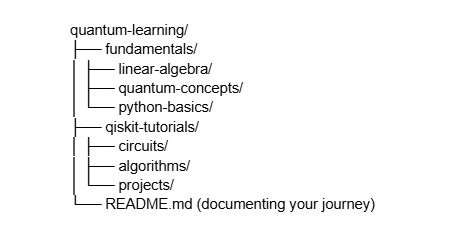
2. Build a Learning Portfolio
GitHub repository structure:
3. Join Communities
- Qiskit Community Slack: Thousands of quantum learners and experts
- Quantum Computing Stack Exchange: Q&A platform
- Reddit r/QuantumComputing: Active discussions
- QuantumJobs USA: Networking and job opportunities
- LinkedIn: Follow quantum leaders and share your progress
4. Engage in Projects
Project ideas by level:
Beginner:
- Bell state entanglement simulator
- Deutsch-Josza algorithm implementation
- Random number generator using quantum circuits
Intermediate:
- Grover's search algorithm
- VQE for molecular ground state
- Quantum teleportation protocol
Advanced:
- Shor's algorithm implementation
- Quantum error correction codes
- Custom quantum machine learning model
5. Document and Share
Write about your learning journey. Share on:
- GitHub repositories with detailed README files
- Medium or Dev. to blog posts
- LinkedIn articles
- Conference talks or meetups
This reinforces learning (the Feynman Technique) and establishes your expertise.
Conclusion
In conclusion, quantum computing is a powerful and exciting field for beginners to learn, and many people are now searching for how to learn quantum computing effectively. With dedication and a clear learning plan, anyone can get started.First, focus on basics like mathematics, Python, and simple quantum concepts. Then practice regularly using tools like Qiskit. With daily effort, you can gain good skills in 6 to 12 months.
With daily effort, you can gain good skills in 6 to 12 months. Learning by doing projects and joining communities helps you grow faster and avoid common mistakes while mastering how to learn quantum computing. Quantum technology is improving quickly, with major progress from companies like IBM and Microsoft. People who start learning early will have strong opportunities in areas like AI, healthcare, and finance. Begin learning now and be ready for the future of quantum computing.