
Quantum computing is one of the fastest-growing fields in modern computer science and physics. As organisations such as Google, IBM, Microsoft, and Amazon continue investing heavily in quantum technologies, the demand for skilled quantum professionals is steadily increasing. For freshers, students, and early-career engineers, preparing for quantum computing interviews can feel overwhelming due to their interdisciplinary nature involving physics, mathematics, and computer science.
Unlike classical computing, quantum computing relies on quantum mechanics principles such as superposition, entanglement, and interference. Interviewers typically assess not only theoretical understanding but also conceptual clarity and problem-solving ability.
This blog covers the most frequently asked quantum computing interview questions for freshers, quantum computing interview question and Answers with real understanding rather than memorised definitions.
Understanding the Basics of Quantum Computing
1. What is quantum computing?
Quantum computing is a new computing paradigm based on the laws of quantum mechanics. Classical computers process information using bits that can be either 0 or 1. Quantum computers, however, use quantum bits called qubits, which can exist in multiple states at the same time.
This difference allows quantum computers to explore many possible solutions simultaneously. While classical computers try one path at a time, quantum computers evaluate many paths together. This makes them extremely powerful for specific problems such as factorisation, optimisation, and molecular simulation.
Quantum computing does not replace classical computing; instead, it complements it by solving problems that are practically impossible for classical systems.
2. What is a Qubit?
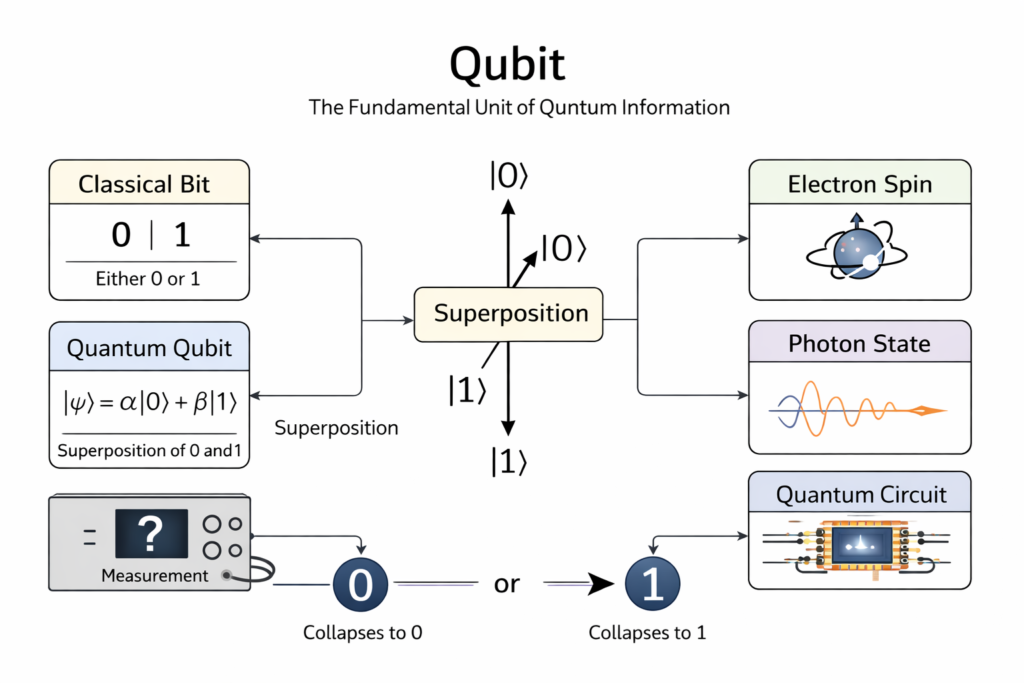
A qubit is the fundamental unit of quantum information. Unlike a classical bit, which holds a single value, a qubit can exist as a combination of 0 and 1 at the same time. This property comes from quantum superposition.
Mathematically, a qubit is represented as a linear combination of two basis states. Physically, it can be implemented using electrons, photons, or superconducting circuits. When measured, the qubit collapses into either 0 or 1 based on probability.
The power of quantum computing begins with the qubit.
3. What is superposition?

Superposition means that a quantum system can exist in multiple states simultaneously. For example, a qubit can be both 0 and 1 at the same time until it is measured.
This does not mean the qubit is randomly switching between states. Instead, it holds a probability distribution. When measured, the system collapses to one definite outcome.
Superposition enables quantum parallelism, allowing quantum computers to process massive combinations at once.
4. What is quantum entanglement?
Entanglement is a quantum phenomenon where two or more qubits become deeply connected. When qubits are entangled, the state of one qubit instantly affects the other, even if they are far apart.
This correlation is stronger than anything seen in classical physics. Entanglement is essential for quantum teleportation, quantum cryptography, and advanced algorithms.
It is one of the main reasons quantum computers outperform classical machines.
5. What happens when a qubit is measured?
Measurement forces a quantum system to collapse into a definite classical state. Before measurement, the qubit exists as probabilities. After measurement, it becomes either 0 or 1.
Once measured, the original quantum information is lost. This is why quantum algorithms delay measurement until the final step.
Understanding measurement is crucial because it explains why quantum programming is very different from classical programming.
6. How is quantum computing different from classical computing?
Classical computing is deterministic and sequential. Every instruction has a predictable result. Quantum computing is probabilistic and parallel.
Classical systems use logic gates like AND and OR. Quantum systems use reversible gates that preserve information. Classical memory can be copied freely, but quantum states cannot be copied due to the no-cloning theorem.
These differences make quantum computing powerful but also extremely challenging.
7. What is a quantum gate?
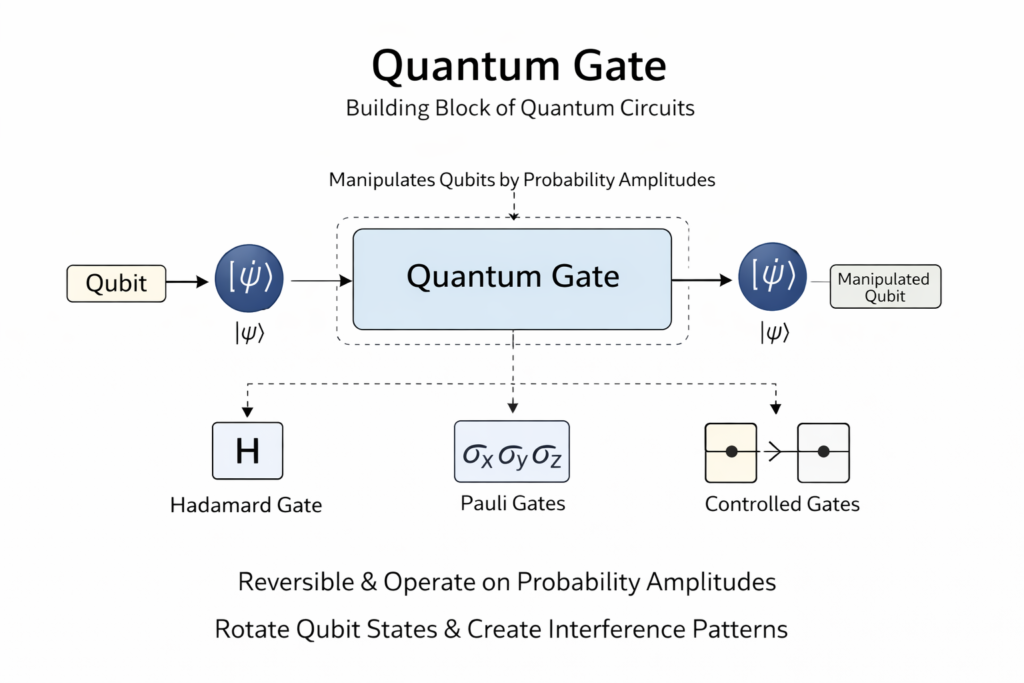
Quantum gates manipulate qubits just like logic gates manipulate bits. However, quantum gates are reversible and operate on probability amplitudes rather than fixed values.
Examples include the Hadamard gate, Pauli gates, and controlled gates. These gates rotate qubit states and create interference patterns.
Quantum gates are the building blocks of quantum circuits.
8. What is the Hadamard Gate?
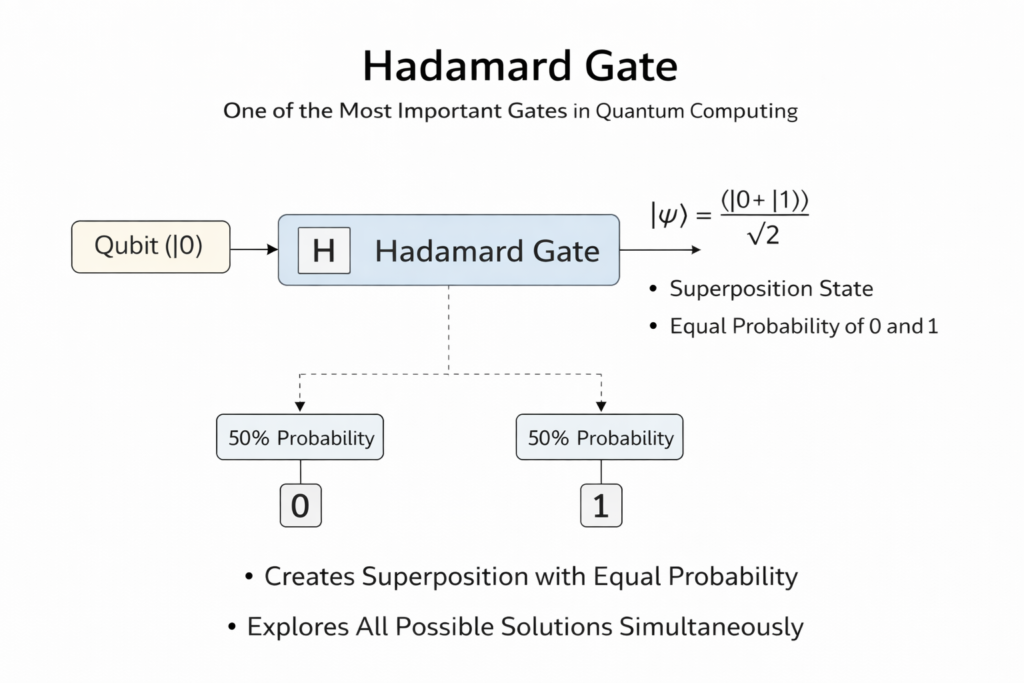
The Hadamard gate creates a superposition. When applied to a qubit in the 0 state, it produces an equal probability of measuring 0 or 1.
Most quantum algorithms begin with Hadamard gates because they allow exploration of all possible solutions simultaneously.
It is one of the most important gates in quantum computing.
9. What is quantum interference?
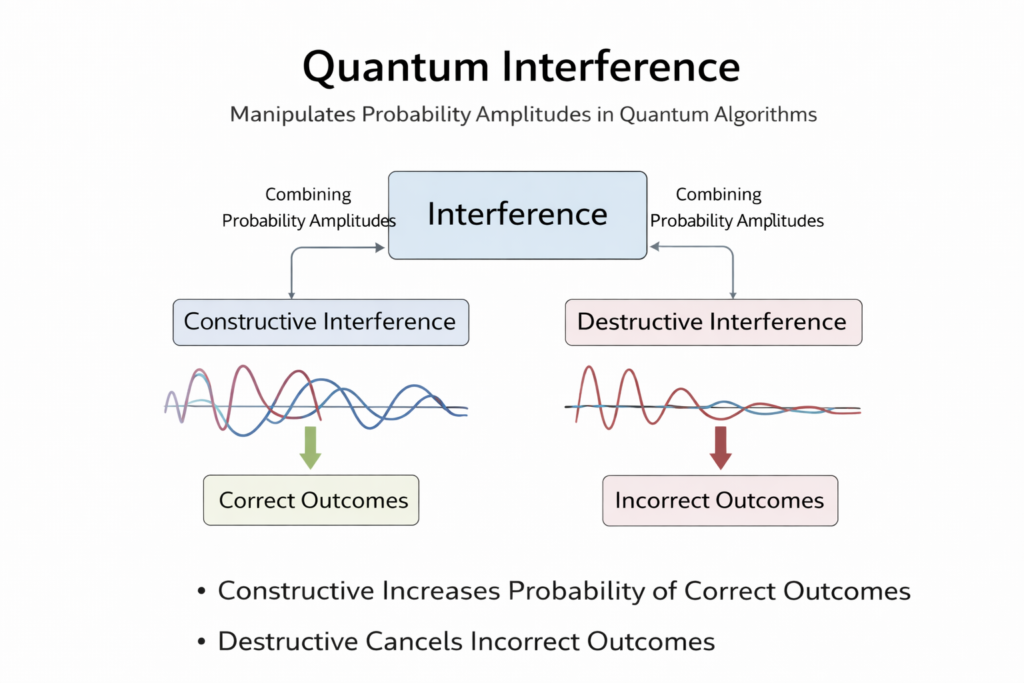
Quantum interference occurs when probability amplitudes combine. Constructive interference increases the probability of correct outcomes, while destructive interference cancels incorrect ones.
Quantum algorithms are carefully designed to guide interference toward correct answers. Without interference, superposition alone would be useless.
10. What is a quantum circuit?
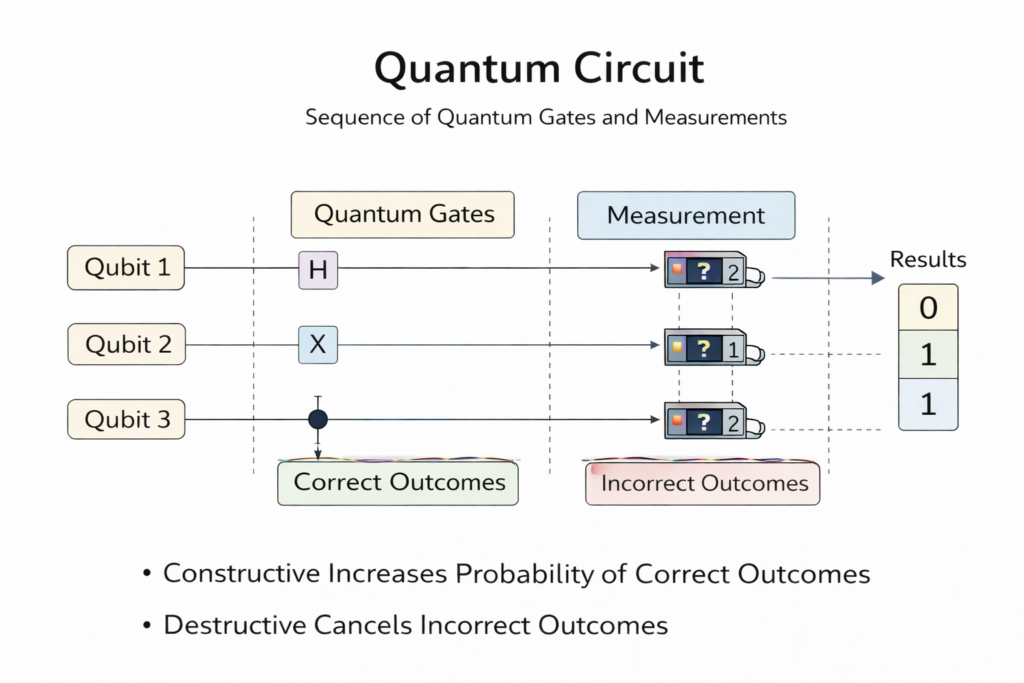
A quantum circuit is a sequence of quantum gates applied to qubits followed by measurement. It visually represents how quantum information flows.
Quantum circuits are used to design algorithms, test ideas, and run programs on quantum hardware or simulators.
Beginner Interview Tips
At the beginner level, interviewers focus on understanding, not equations. Always explain concepts using intuition. Avoid memorised definitions. Use simple examples such as coins, probabilities, or switches. Showing curiosity matters more than perfection.
Intermediate-Level Quantum Computing Interview Questions
These questions test deeper understanding and practical reasoning.
11. Why must quantum gates be reversible?
Quantum mechanics requires that information cannot be destroyed. Therefore, all quantum operations must be reversible.
In classical computing, irreversible operations lose information, but quantum systems must preserve probability amplitudes. This is why quantum gates are represented using unitary matrices.
Reversibility ensures that quantum evolution follows physical laws.
12. What is decoherence?
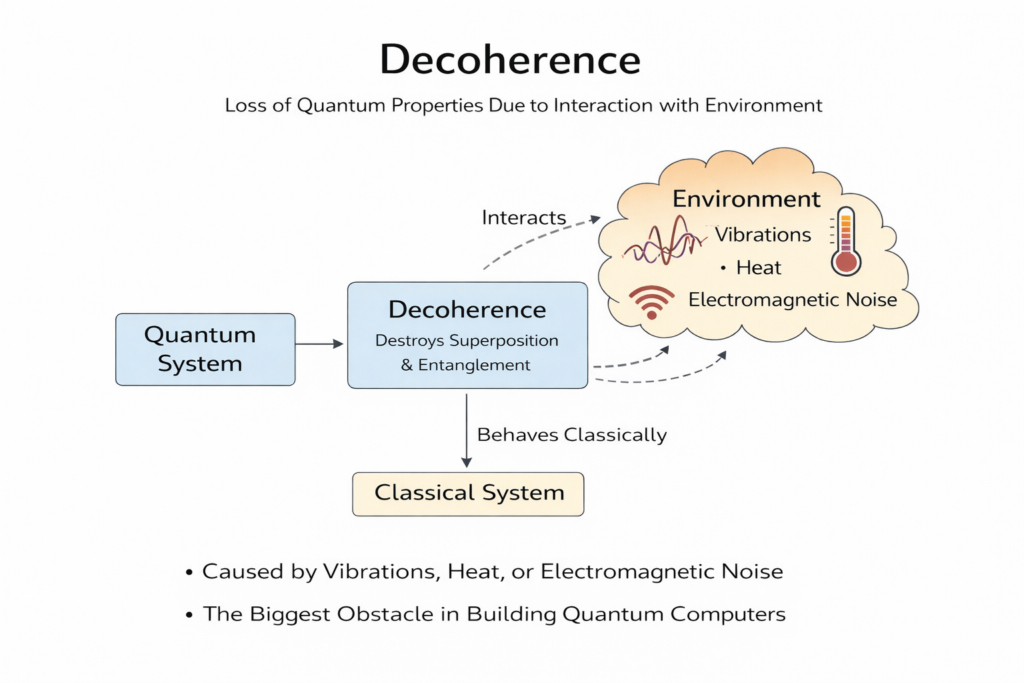
Decoherence occurs when a quantum system interacts with its environment. This interaction destroys superposition and entanglement.
Even tiny vibrations, heat, or electromagnetic noise can cause decoherence. Once decoherence occurs, the quantum system behaves classically.
Decoherence is the biggest obstacle in building large-scale quantum computers.
13. What is quantum noise?
Quantum noise refers to errors introduced by imperfect hardware, environmental interference, and inaccurate gate operations.
Noise leads to incorrect computations and limits circuit depth. Current quantum devices are noisy, which is why they are called NISQ devices.
14. What is quantum error correction?
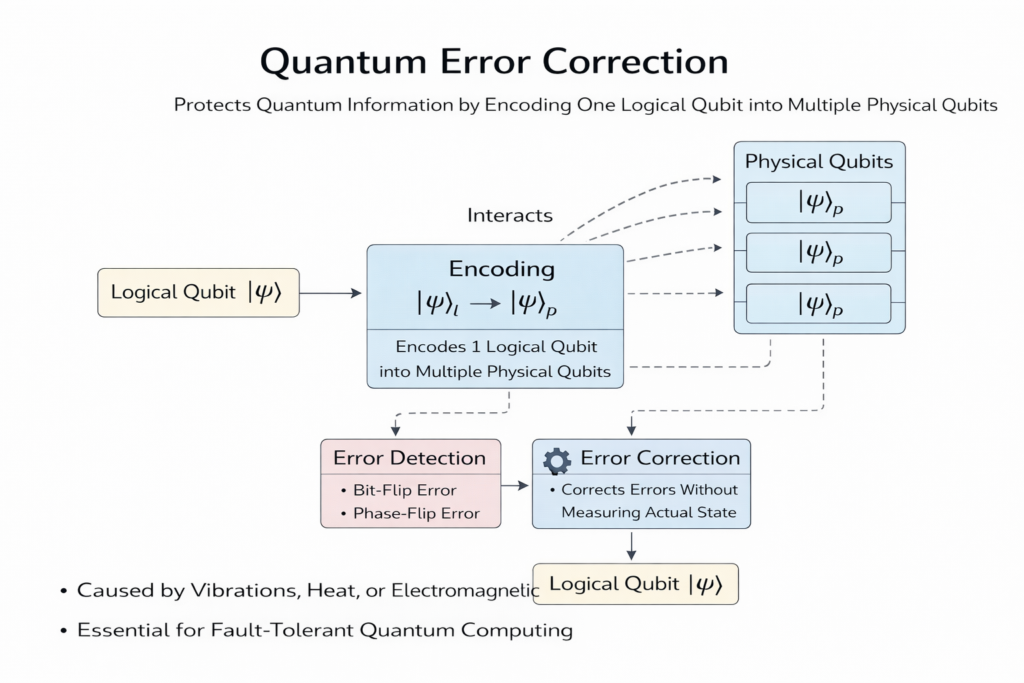
Quantum error correction protects quantum information by encoding one logical qubit into multiple physical qubits.
Instead of copying states, it detects error patterns without measuring actual data. This allows correction of bit-flip and phase-flip errors.
Error correction is essential for fault-tolerant quantum computing.
15. What is the no-cloning theorem?
The no-cloning theorem states that it is impossible to make an identical copy of an unknown quantum state.
This principle ensures security in quantum cryptography but complicates error correction and debugging.
16. What is the Bloch sphere?
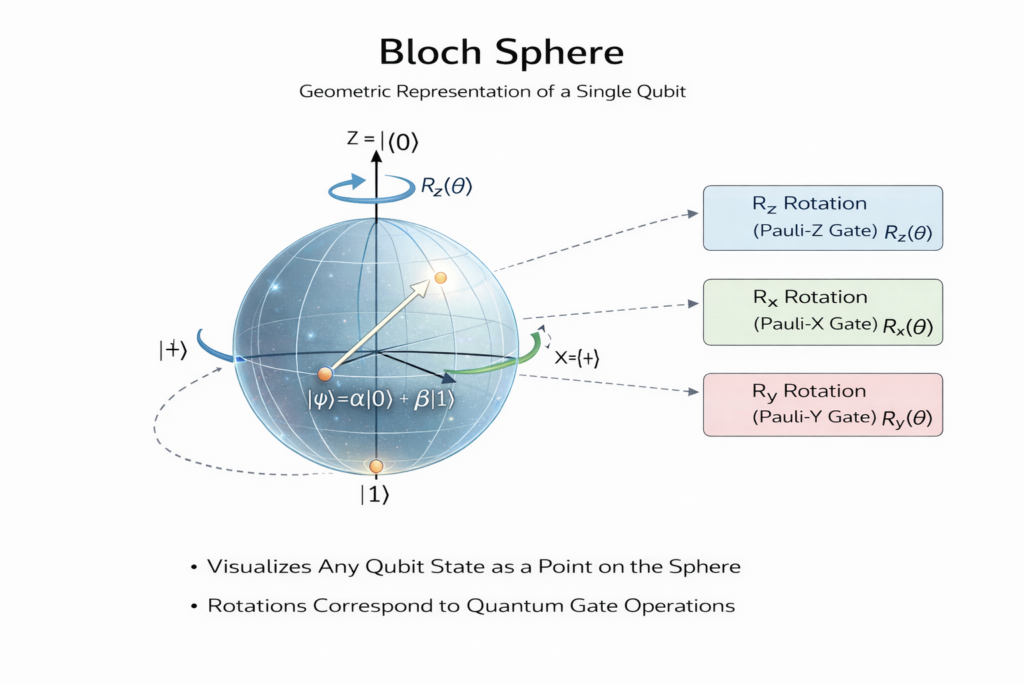
The Bloch sphere is a geometric representation of a single qubit. Any qubit state can be visualised as a point on the sphere.
Rotations on the Bloch sphere correspond to quantum gate operations. It helps visualise how gates manipulate qubits.
17. What is quantum parallelism?
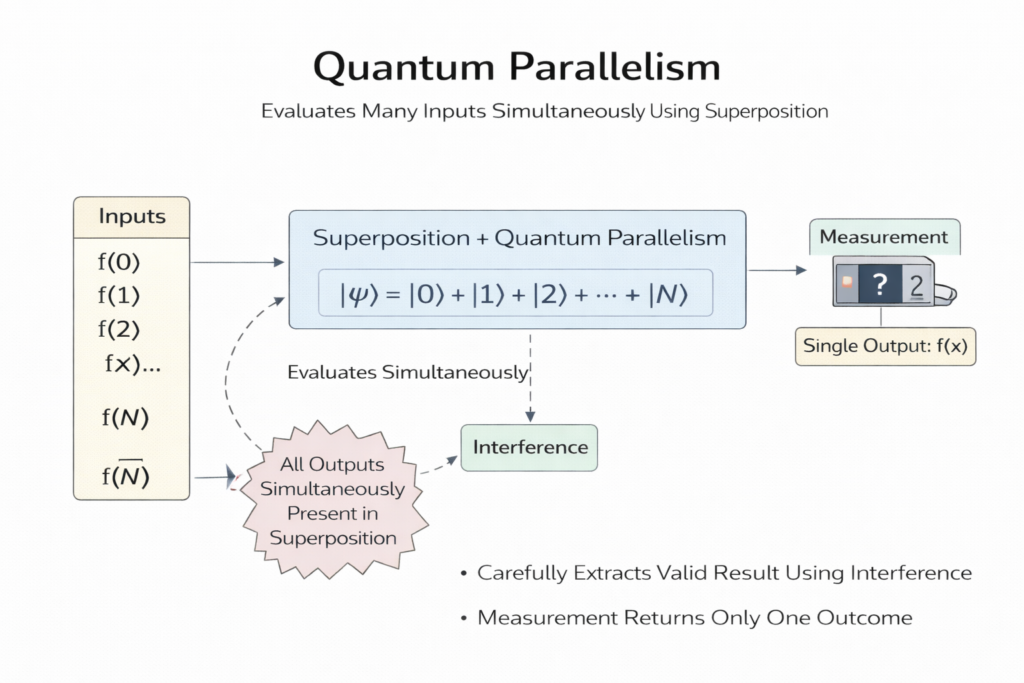
Quantum parallelism allows a quantum computer to evaluate many inputs simultaneously using superposition.
However, results must be carefully extracted using interference. Otherwise, measurement returns only one outcome.
18. What is a quantum simulator?
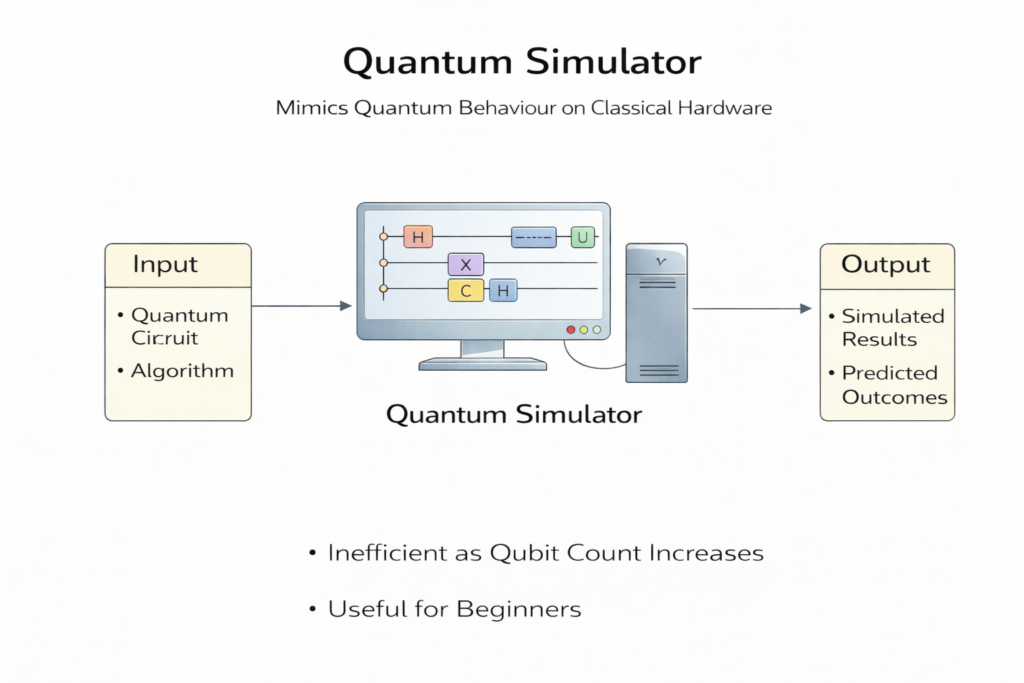
A quantum simulator mimics quantum behaviour on classical hardware. It is mainly used for learning and testing algorithms.
Simulators become inefficient as qubit count increases, but they are extremely useful for beginners.
19. What is hybrid quantum computing?
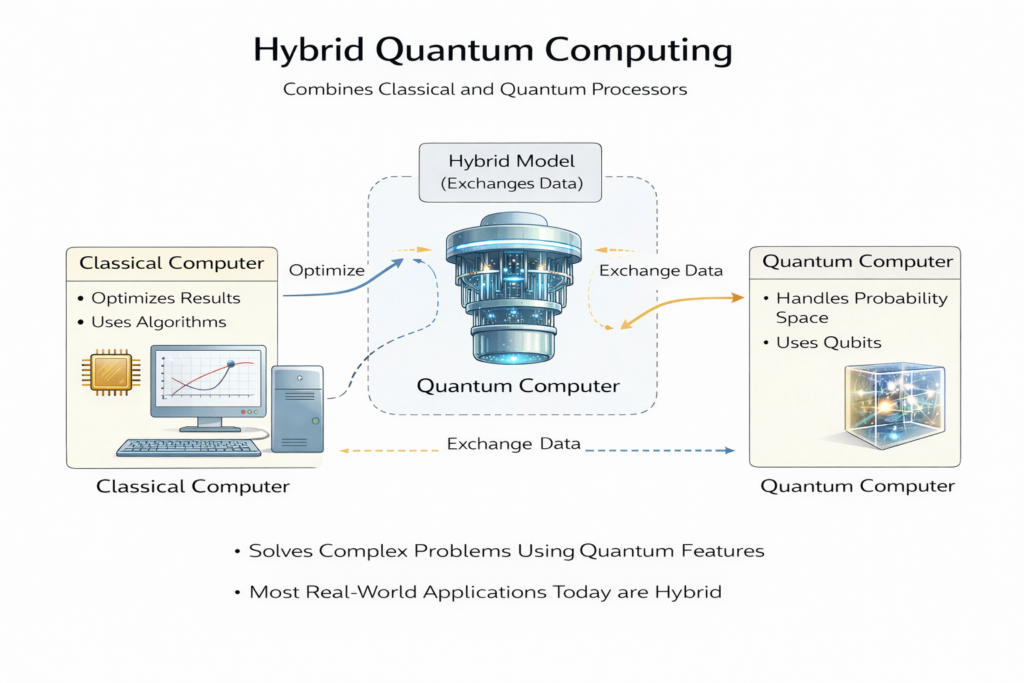
Hybrid models combine classical and quantum processors. The quantum computer handles complex probability spaces while the classical computer optimizes results.
Most real-world quantum applications today are hybrid.
20. What is NISQ?
NISQ stands for Noisy Intermediate-Scale Quantum devices. These machines have limited qubits and high noise.
Current research focuses on extracting useful results despite imperfections.
Intermediate Interview Tips
At this stage, interviewers want logical clarity. You should be able to explain why problems exist, not just name them. Showing awareness of limitations demonstrates maturity and a realistic understanding.
Advanced-Level Quantum Computing Interview Questions
These questions evaluate conceptual depth and future understanding.
21. What is Shor’s algorithm?
Shor’s algorithm factors large numbers exponentially faster than classical algorithms.
Its importance lies in cryptography. Many encryption systems rely on factorisation being difficult. Shor’s algorithm threatens these systems once large quantum computers become practical.
22. What is Grover’s algorithm?
Grover’s algorithm speeds up searching unsorted databases.
Instead of checking items one by one, it amplifies the probability of the correct answer using interference.
It provides quadratic speedup.
23. What is the quantum Fourier Transform?
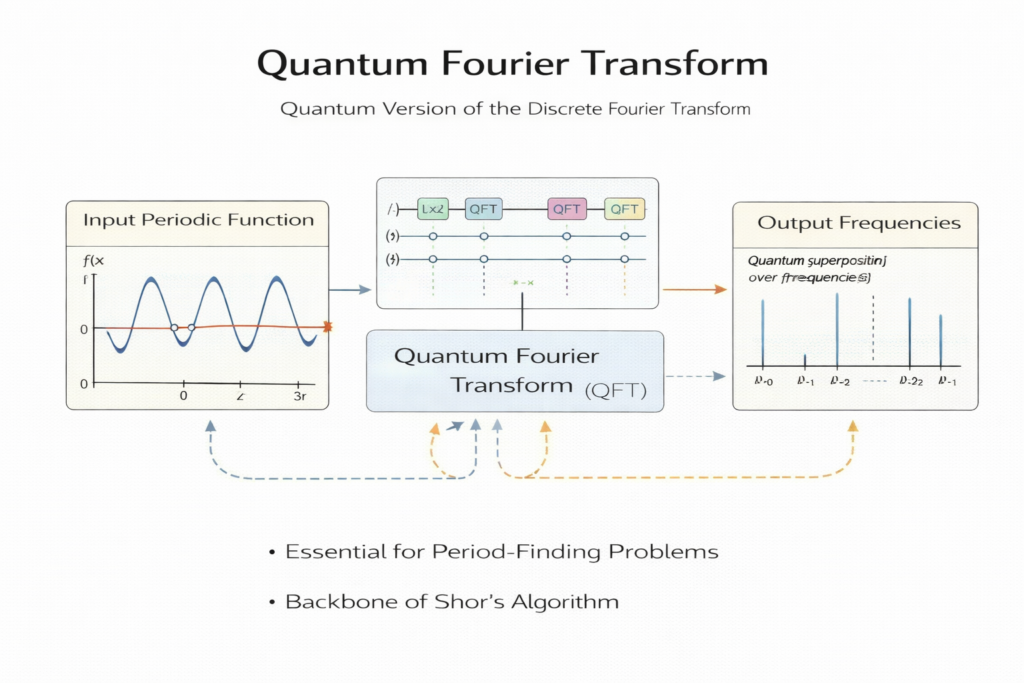
QFT is the quantum version of the discrete Fourier transform.
It is essential for period-finding problems and forms the backbone of Shor’s algorithm.
24. What is amplitude amplification?
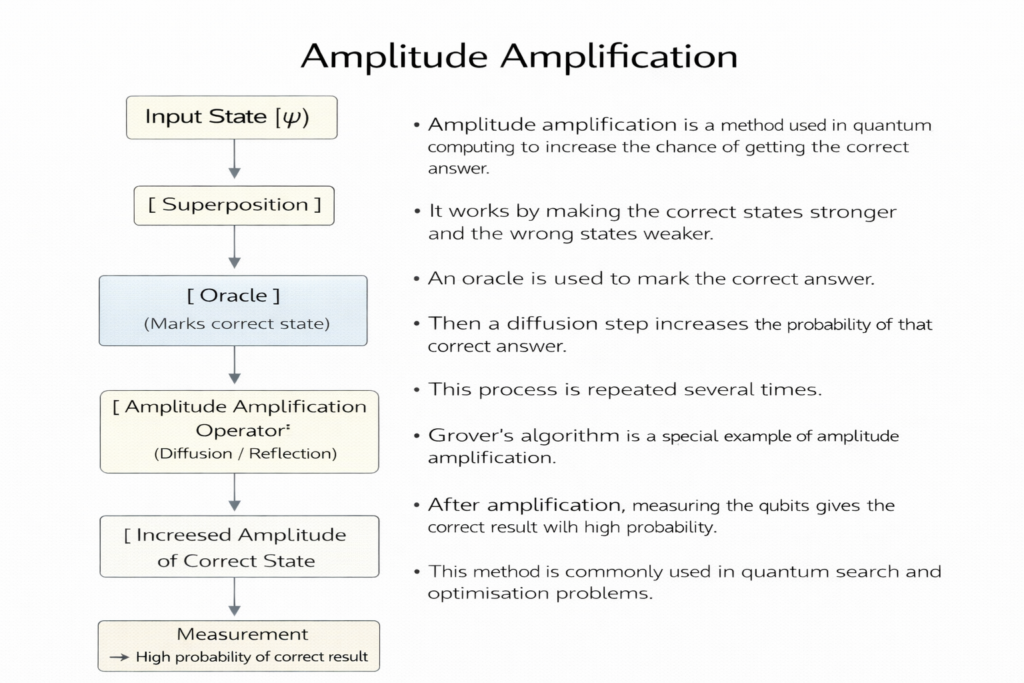
Amplitude amplification is a method used in quantum computing to increase the chance of getting the correct answer.
- It works by making the correct states stronger and the wrong states weaker.
- An oracle is used to mark the correct answer.
- Then a diffusion step increases the probability of that correct answer.
- This process is repeated several times.
- Grover’s algorithm is a special example of amplitude amplification.
- After amplification, measuring the qubits gives the correct result with high probability.
This method is commonly used in quantum search and optimisation problems.
25. What is quantum teleportation?
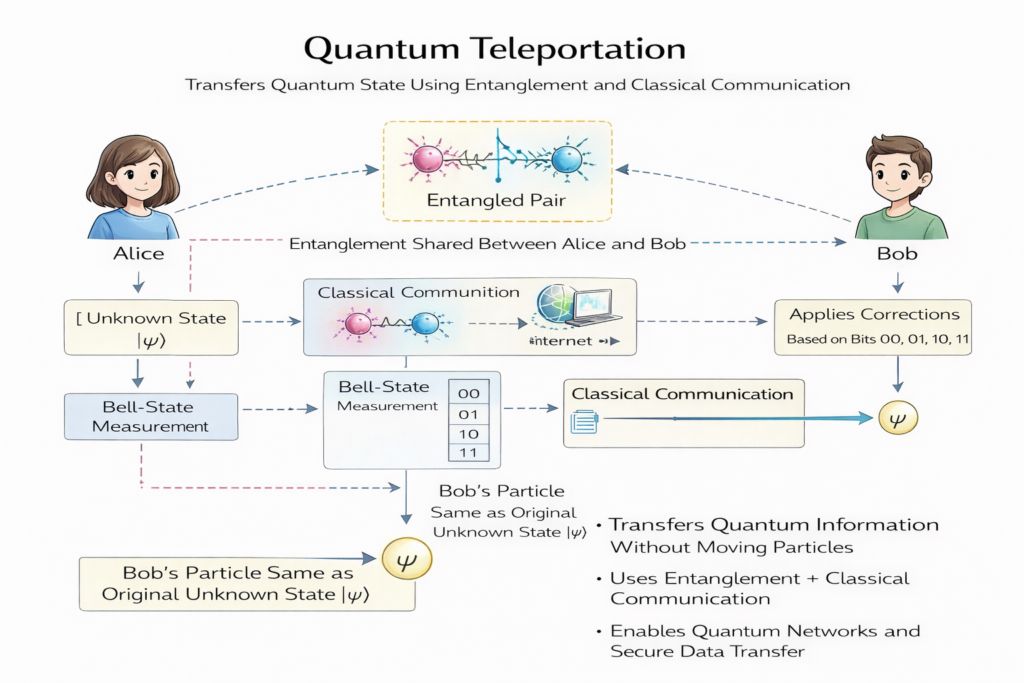
Quantum teleportation is a method used in quantum computing to send the state of a particle from one place to another without moving the particle itself. It does not move matter or energy; it only transfers quantum information.
This process uses quantum entanglement and normal (classical) communication. First, two people, usually called Alice and Bob, share a pair of entangled particles. Alice also has the particle whose state she wants to send. She measures her two particles together, which destroys the original state but creates some classical information. Alice then sends this information to Bob using a normal communication channel, like the internet. After receiving it, Bob applies simple operations to his particle. His particle then becomes exactly the same as the original one Alice had.
Quantum teleportation is important for quantum communication, quantum networks, and secure data transfer because it allows quantum information to be sent safely and accurately.
26. What is quantum supremacy?
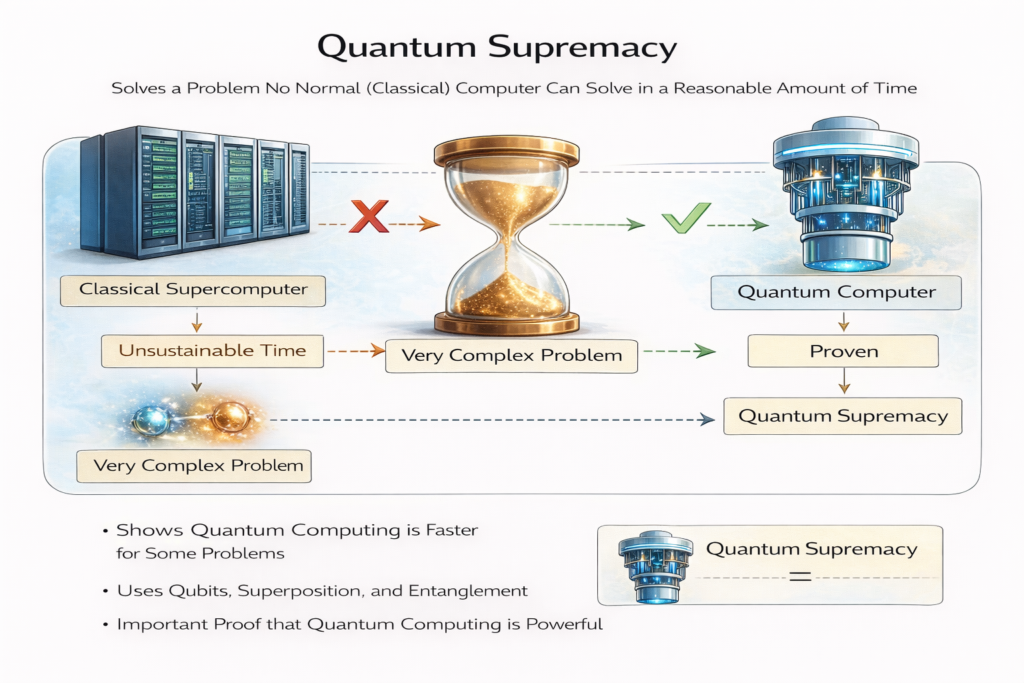
Quantum supremacy means the stage where a quantum computer can solve a problem that a normal (classical) computer cannot solve in a reasonable amount of time. It does not mean quantum computers are better at all tasks, only that they are faster for some special problems.
This idea was shown when a quantum computer completed a very complex calculation much faster than the world’s best supercomputers. Although this calculation did not have a direct practical use. It proved that quantum computers work in a new and powerful way. They use qubits, superposition, and entanglement to process information differently from classical computers.
Quantum supremacy is important because it proves that quantum computing is no longer just a theory. It can actually perform tasks that classical computers cannot handle efficiently.
27. What is variational quantum computing?
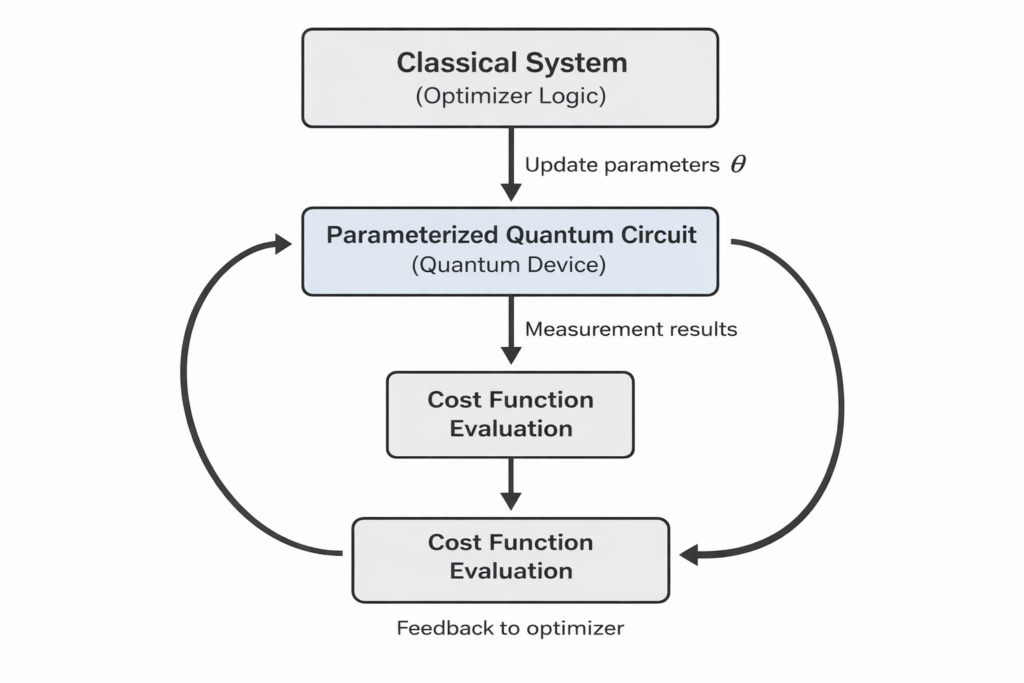
Variational quantum computing is a way to solve problems by using a quantum computer and a classical computer together. The quantum computer runs a circuit with adjustable values, called parameters. The classical computer changes these values to make the result better.
First, the quantum computer creates and measures quantum states. Then, the classical computer studies the results and decides how to adjust the parameters. This cycle is repeated many times until a good solution is found.
This method is helpful because it works well with today’s small and noisy quantum computers. Variational quantum computing is mainly used for optimization problems, chemistry simulations, and machine learning tasks.
28. What is VQE?
The Variational Quantum Eigensolver (VQE) is a method that uses both a quantum computer and a classical computer to find the lowest energy state of a system. It is mostly used in quantum chemistry and material science.
In VQE, the quantum computer creates a quantum state using adjustable settings and measures its energy. The classical computer then checks the result and changes the settings to make the energy lower. This process is repeated again and again until the lowest energy is found.
VQE is important because it works well with today’s small and noisy quantum computers, making it useful for current quantum technology.
29. What is QAOA?
The Quantum Approximate Optimization Algorithm (QAOA) is a method that uses both quantum and classical computers to solve optimization problems. Like scheduling, routing, and graph-related tasks.
In QAOA, the quantum computer creates a quantum state using a series of steps with adjustable values. The classical computer then checks the results and changes these values to make the solution better. This process is repeated many times until a good solution is found.
QAOA is useful because it works well on today’s small and noisy quantum computers. Which is making it suitable for current and near-future quantum technology.
30. What is the future of quantum computing?
The future of quantum computing is very bright, but progress will happen slowly and step by step. In the near future, quantum computers will work together with classical computers to solve certain problems faster, especially in optimization, chemistry, materials science, and machine learning.
As technology improves, quantum computers will become more stable, less noisy, and more powerful. This can help scientists discover new medicines, better batteries, stronger materials, and faster ways to design drugs. Quantum computing may also help improve artificial intelligence and make business systems more efficient.
In the long run, powerful quantum computers may change data security, leading to new and safer encryption methods. Quantum computers will not replace normal computers, but they will help solve problems that are very hard today.
Advanced Interview Tips
Interviewers do not expect mastery. They expect awareness. Even a partial understanding with honest curiosity leaves a strong impression. Always connect concepts to real-world applications.
Conclusion
Quantum computing interviews do not test how many formulas you remember, but how well you understand the core ideas behind the technology. A strong foundation in basic concepts such as qubits, superposition, and entanglement helps you think logically and explain answers with confidence. By practicing regularly, experimenting with tools like Qiskit, and focusing on conceptual clarity, freshers can gradually build confidence in this advanced field. Clear thinking, curiosity, and the ability to simplify complex ideas are far more valuable than memorization. With consistent learning and patience, anyone can prepare effectively for quantum computing interviews and future opportunities.