
A Database Management System (DBMS) is a very important subject in computer science. It is also an important topic in technical interviews. Almost every modern app, like banking apps and online shopping websites, uses databases to store and manage data properly. That is why companies ask database management system interview questions to check if a student understands basic concepts like data, tables, keys, relationships, and SQL.
For freshers, having good knowledge of DBMS increases confidence and helps in getting jobs. In this article, you will learn important DBMS concepts and common interview questions in very simple and easy way.
What is a Database Management System (DBMS)?
A Database Management System (DBMS) is a type of software that helps us store, manage, update, and find data easily. Instead of writing information in notebooks or saving it in simple files, a DBMS stores data digitally in an organized way.
For example, when you create an account on a website, your username, password, email, and phone number are stored in a database with the help of a DBMS. This makes it easy for the website to manage millions of users properly.
In job interviews, this is usually the first question asked in database management system interview questions for freshers.
Why is DBMS Important for Interviews?
1. DBMS is Used in Real Life
Almost every company stores different types of data, such as:
- Customer details
- Employee records
- Product information
- Bank transactions
All this information is stored and managed using a DBMS. It helps companies keep data safe, organized, and easy to find.
That is why companies ask DBMS questions in interviews. They want to check if you understand how data is stored, organized, and managed in real-world systems.
2. It Shows Your Basic Knowledge
DBMS is a very important subject in Computer Science. If you understand DBMS well, it shows that:
- You understand what databases are and how they work.
- You know how data is organized in tables.
- You are able to work on real-world applications that use databases.
This is why DBMS knowledge is very important for students and also for job interviews.
3. Important for Many Job Roles
DBMS knowledge is required for many job roles, such as:
- Software Developer
- Data Analyst
- Backend Developer
- Database Administrator
- Full Stack Developer
These jobs work with data and databases every day. So, interviewers ask DBMS questions to check if you are ready to handle these roles and work on real projects.
4. Helps in Writing Good Code
When you understand DBMS well:
- You can write better and faster SQL queries.
- You can design databases in a proper and organized way.
- You can reduce mistakes and avoid data errors.
All these skills help you become a better and more confident programmer.
5. Frequently Asked in Interviews
DBMS questions are very common in:
- Technical interviews
- Campus placements
- Government IT exams
Topics like:
- Normalization
- Keys (Primary key, Foreign key)
- SQL queries
- Transactions
- ACID properties
are often asked.
Database Management System Interview Questions for Freshers (Basics)
1. What is a Database Management System (DBMS)?
A Database Management System (DBMS) is software that helps users store and manage data in a safe and organized way. Instead of keeping information in different files, a DBMS stores data in tables. This makes it easy to search, update, and delete data.
A DBMS also allows many users to use the same data at the same time without problems. It keeps data correct, reduces repetition, and provides backup and recovery features.
Because of these benefits, DBMS is used in banks, websites, mobile apps, hospitals, and schools. This is one of the most common database management system interview questions for freshers.
2. What is a database?
A database is a collection of related data that is stored in an organized way. It is arranged in a structured format so that it can be easily accessed, managed, and updated.
For example, a school database may store student names, roll numbers, classes, and marks. Instead of writing this information in notebooks or saving it in simple files, a database stores it digitally in tables.
Databases help keep information correct and consistent. They also make it easy and fast to find data, even if millions of records are stored. In database management system interview questions, this is often asked to check basic understanding of how data is stored in real systems.
3. What is data?
Data means raw facts and figures that do not have a clear meaning on their own. It can be numbers, words, symbols, or even images.
For example, numbers like 85, 90, and 72 are data. By themselves, they do not explain anything. But when we organize them as student marks, they start to make sense.
Data becomes useful only after it is arranged and analyzed. In DBMS, data is stored so it can later be changed into meaningful information. Understanding data is very important because database management system interview questions are mostly about how data is stored, kept safe, and used properly in real applications.
4. What is information?
Information is data that has been processed and given meaning. When raw data is arranged, analyzed, and understood, it becomes information.
For example, student marks are just data. But when those marks are calculated into percentages and grades, they become useful information.
In a DBMS, the main aim is to turn large amounts of data into meaningful information that helps people make decisions. Information is more useful than data because it gives clear understanding. That is why this question is often asked in database management system interview questions and answers to check basic concepts.
5. What is the difference between data and information?
The main difference between data and information is meaning.
Data is raw and unprocessed facts. Information is processed data that has clear meaning.
Data alone cannot help in making decisions, but information can. For example, a simple list of numbers is data. But a report showing the highest and lowest marks is information.
In DBMS, data is stored in tables, and SQL queries are used to change it into useful information. This question is often asked in database management system interview questions for freshers to check basic understanding.
6. What is a table in DBMS?
A table is the basic structure used to store data in a database. It consists of rows and columns, similar to an Excel sheet. Each row represents a record, and each column represents an attribute. For example, in a student table, each row represents one student, while columns represent name, roll number, and marks. Tables help organize data in a clean and readable format. DBMS uses tables to perform operations like searching, updating, and deleting data efficiently. Almost all interview questions in a database management system start with understanding tables because they form the foundation of databases.
7. What is a record?
A record is a complete set of related information stored in a single row of a table. For example, all details of one student, such as roll number, name, class, and marks, together form a record. Each record represents one real-world entity. In DBMS, records are important because database operations usually work on records. Insert, update, and delete commands directly affect records. Interviewers often include this question in database management system interview questions and answers to ensure candidates understand how data is structured inside tables.
8. What is a field or attribute?
A field, also known as an attribute, represents a column in a table. It describes a specific property of an entity. For example, student name, age, and roll number are attributes of a student. Each field has a defined data type, such as integer, character, or date. Attributes help in defining the structure of a table. In DBMS interview questions, this topic is important because proper attribute design ensures data accuracy, reduces errors, and improves overall database performance in real-life applications.
9. What is a primary key?
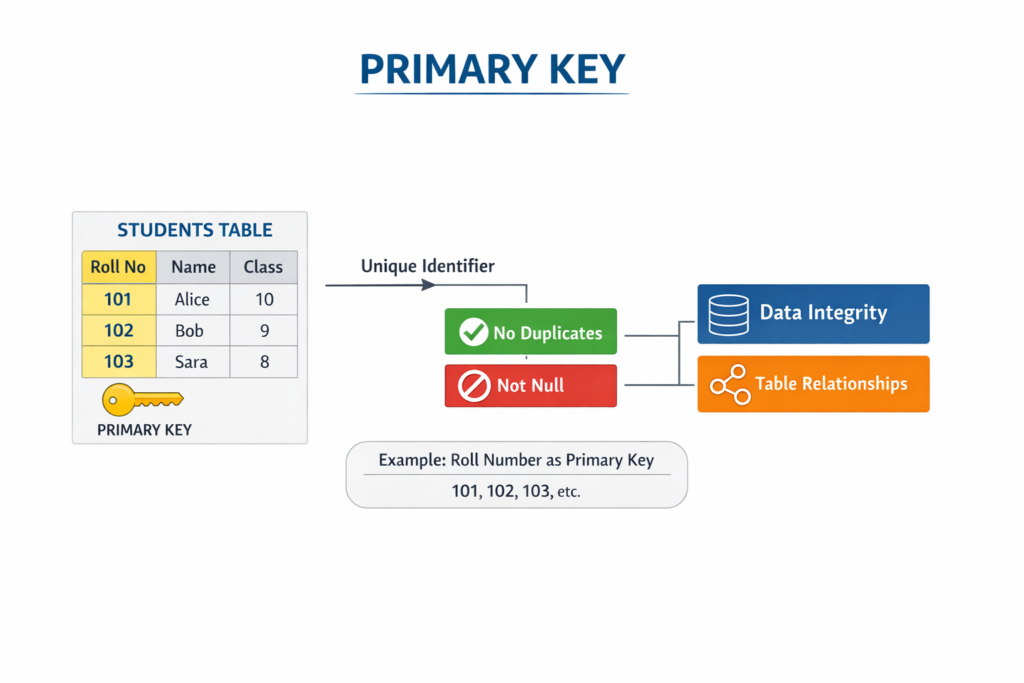
A primary key is a column or a set of columns that uniquely identifies each record in a table. It ensures that no two rows have the same value. A primary key cannot be null and cannot contain duplicate values. For example, a student's roll number can be a primary key because it is unique for every student. Primary keys help maintain data integrity and enable relationships between tables. This is one of the most important database management system interview questions for freshers and is almost always asked during technical interviews.
10. What is a foreign key?
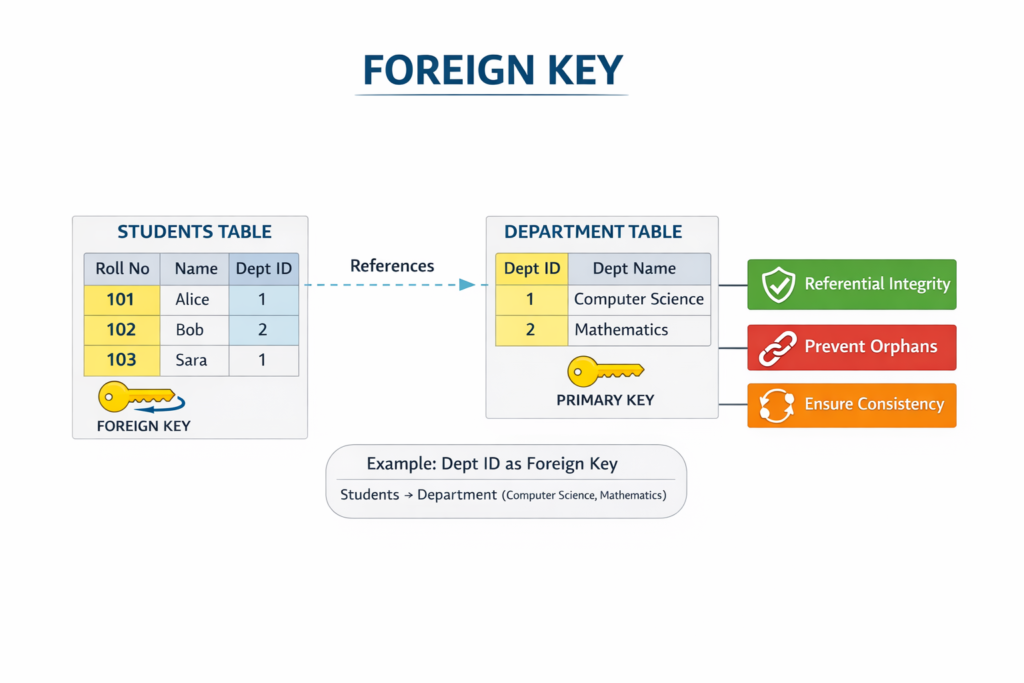
A foreign key is a column in one table that refers to the primary key of another table. It is mainly used to create relationships between two tables. For example, a student table may have a department ID that refers to the department table. Foreign keys help maintain referential integrity, ensuring that invalid data is not entered. They prevent orphan records and keep data consistent across tables. Interviewers include this topic in interview questions in the database management system to test understanding of table relationships.
11. What is data redundancy?
Data redundancy means storing the same data multiple times in different places. This can lead to inconsistency and wastage of storage. For example, if a student’s phone number is stored in multiple tables, updating it everywhere becomes difficult. DBMS reduces data redundancy by using normalization and relational design. Reducing redundancy improves data accuracy and saves storage space. This topic is very important in database management system interview questions and answers because redundancy was a major problem in traditional file systems.
12. What is data integrity?
Data integrity refers to the accuracy, consistency, and reliability of data stored in a database. DBMS ensures data integrity by using constraints such as primary key, foreign key, and not-null constraints. These rules prevent invalid or duplicate data from entering the system. For example, a student ID cannot be empty or repeated. Maintaining data integrity is essential because incorrect data can lead to wrong business decisions. This concept is frequently discussed in database management system interview questions for freshers.
13. What is data consistency?
Data consistency means that data remains the same across the entire database. When a value is updated in one place, it should reflect correctly everywhere. DBMS ensures consistency through transactions and constraints. For example, when money is transferred between bank accounts, both debit and credit must happen together. If only one happens, data becomes inconsistent. Interviewers often ask this in database management system interview questions to evaluate understanding of reliable data management.
14. What is a DBMS constraint?
Constraints are rules applied to database columns to maintain data accuracy and integrity. They restrict the type of data that can be stored. Common constraints include primary key, foreign key, unique, not null, and check constraints. These rules prevent invalid data entry and protect database quality. For example, age cannot be negative if a check constraint is applied. Constraints play a major role in real-world systems, which is why they are frequently included in interview questions in a database management system.
15. What is normalization in DBMS?
Normalisation is the process of organizing data in a database to reduce redundancy and improve data integrity. It involves dividing large tables into smaller tables and establishing relationships between them. Normalization helps avoid update, insert, and delete anomalies. It also makes the database more efficient and easier to maintain. There are different normal forms such as 1NF, 2NF, and 3NF. This topic is extremely important and appears in almost all database management system interview questions and answers.
16. What is denormalisation?
Denormalisation is the process of intentionally adding redundancy to improve database performance. It is mainly used in reporting systems where fast data retrieval is more important than storage efficiency. While normalisation reduces redundancy, denormalisation increases it for speed. This technique is commonly used in data warehouses. Interviewers ask this question to test whether candidates understand real-world trade-offs. It is an advanced yet important concept in database management system interview questions.
17. What is SQL?
SQL stands for Structured Query Language. It is used to communicate with databases. Using SQL, users can create tables, insert data, update records, delete data, and retrieve information. SQL is widely used in almost all relational databases such as MySQL, Oracle, and SQL Server. Learning SQL is essential for backend development and data analysis. Because of its importance, SQL-related topics form a major part of database management system interview questions for freshers.
18. What is a query?
A query is a request made to the database to retrieve or manipulate data. It is written using SQL commands. For example, a SELECT query retrieves data from tables. Queries help users interact with the database efficiently. Complex queries can filter, sort, group, and join data from multiple tables. Interviewers often ask about queries in interview questions in a database management system because queries are used daily in real-world database operations.
19. What is a DBMS schema?
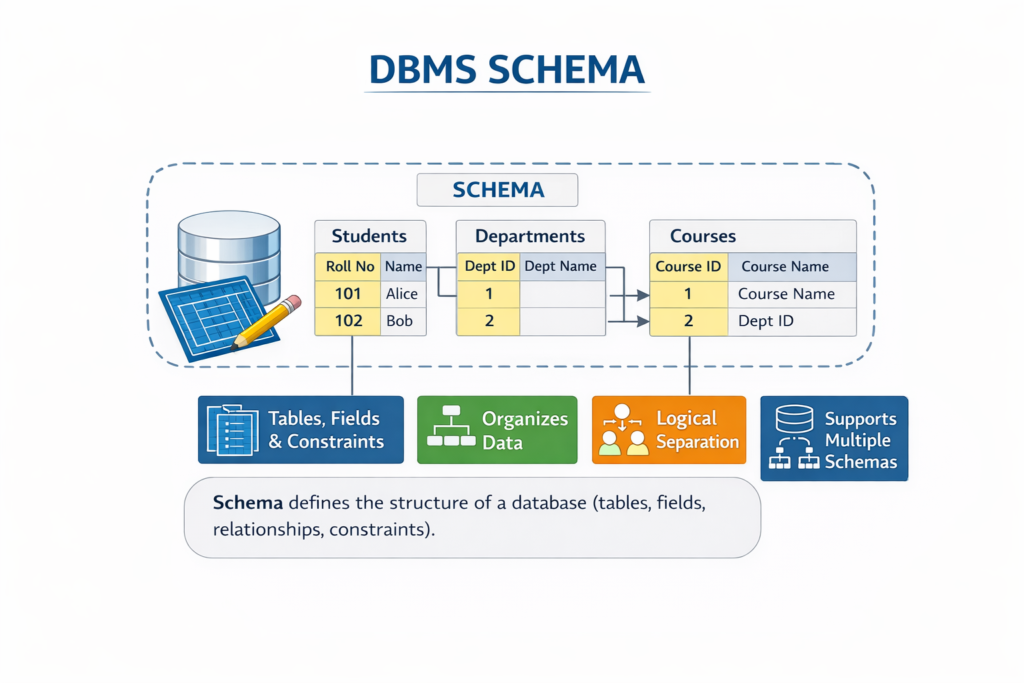
A schema defines the structure of a database, including tables, fields, relationships, and constraints. It acts as a blueprint of the database. A schema helps users understand how data is organized. It also provides logical separation between different users. DBMS supports multiple schemas in one database. This question is commonly asked in database management system interview questions and answers to check design-level understanding.
20. What is a database instance?
A database instance refers to the actual data stored in the database at a particular moment. While a schema defines structure, an instance represents current data values. For example, student records stored today form the database instance. Instances change frequently as data is inserted, updated, or deleted. Understanding the difference between schema and instance is important for conceptual clarity. This question is often asked in database management system interview questions for freshers.
Keys, Relationships & ER Model
Database Management System Interview Questions for Freshers related to the Keys, Relationships & ER Model:
21. What is a candidate key?
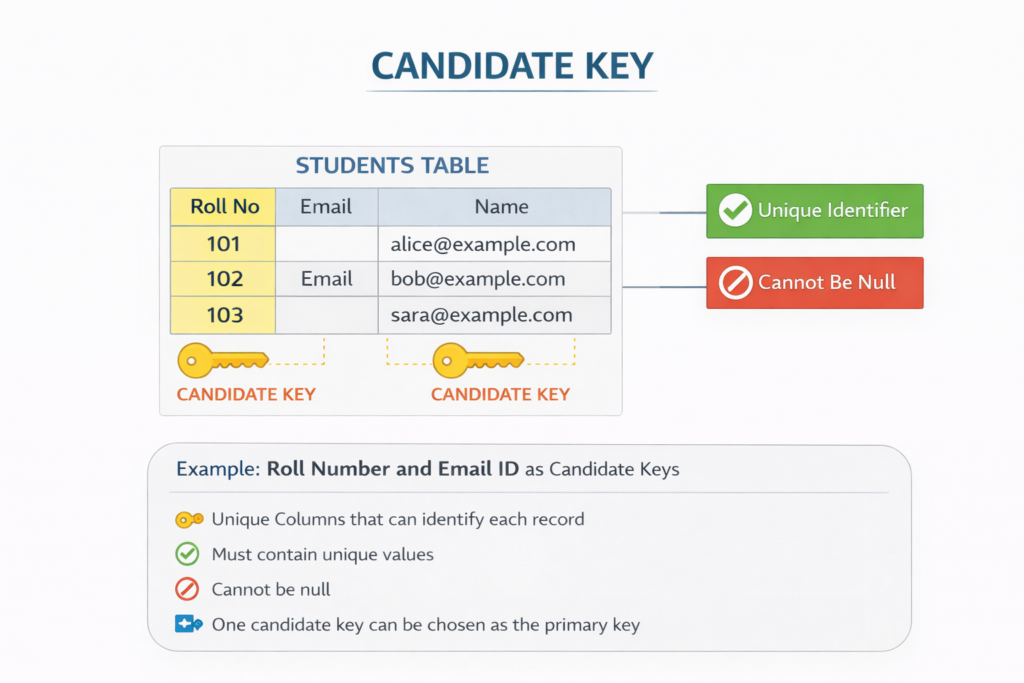
A candidate key is a column or a group of columns that can uniquely identify each record in a table. In a table, there can be multiple candidate keys, but only one of them is chosen as the primary key. For example, in a student table, both roll number and email ID can uniquely identify a student. Therefore, both are candidate keys. Candidate keys must contain unique values and cannot be null. Understanding candidate keys is important because they help database designers decide the best primary key. This concept is often included in database management system interview questions and answers to test basic database design knowledge.
22. What is a super key?
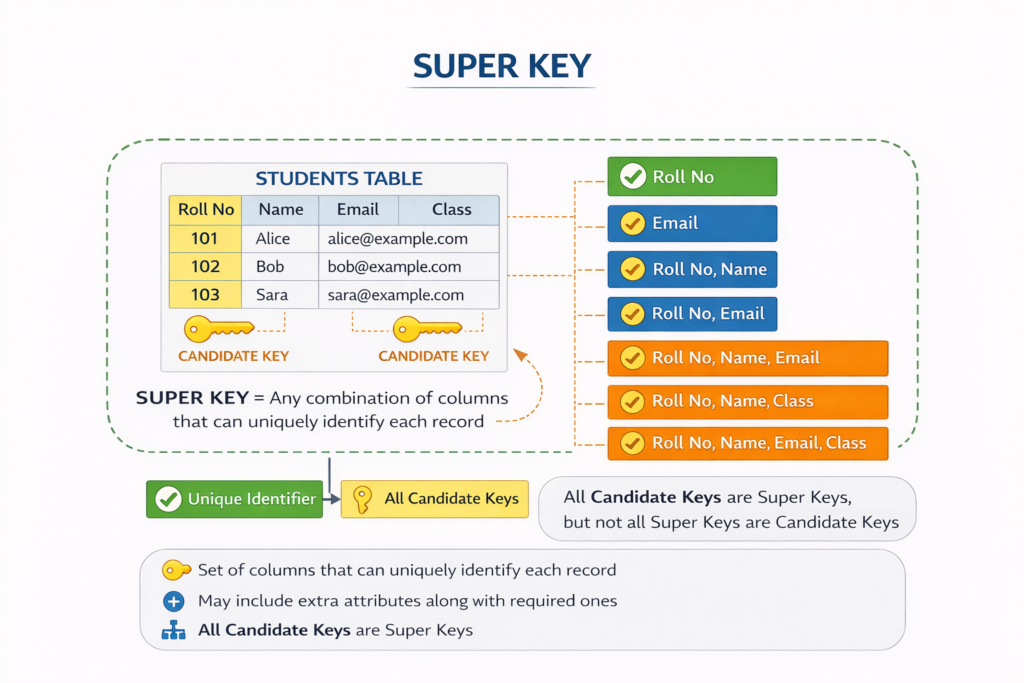
A super key is any set of one or more attributes that can uniquely identify a record in a table. It may contain extra attributes along with the required ones. For example, a combination of roll number and student name can be a super key, even though roll number alone is sufficient. All candidate keys are super keys, but not all super keys are candidate keys. Super keys help in understanding uniqueness within a table. Interviewers often ask this question in interview questions in a database management system to check whether candidates understand the hierarchy of keys clearly.
23. What is an alternate key?
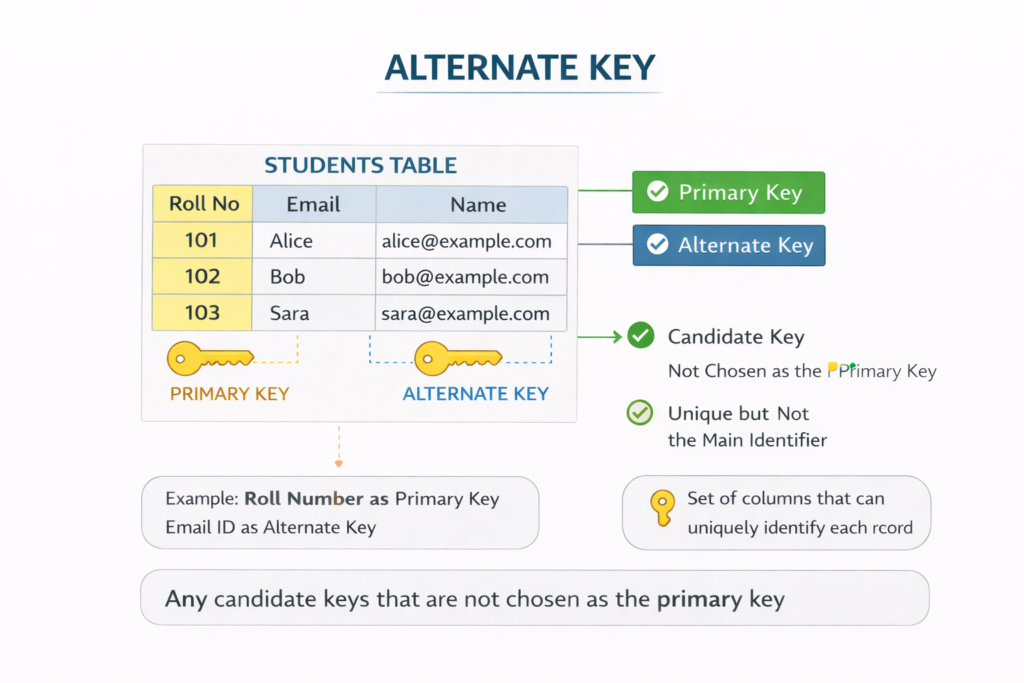
An alternate key is a candidate key that is not selected as the primary key. Since a table can have multiple candidate keys, one is chosen as the primary key, and the remaining candidate keys become alternate keys. For example, if the roll number is selected as the primary key, then the email ID becomes an alternate key. Alternate keys still maintain uniqueness but are not used as the main identifier. This concept is important in database design and commonly appears in database management system interview questions for freshers.
24. What is a composite key?
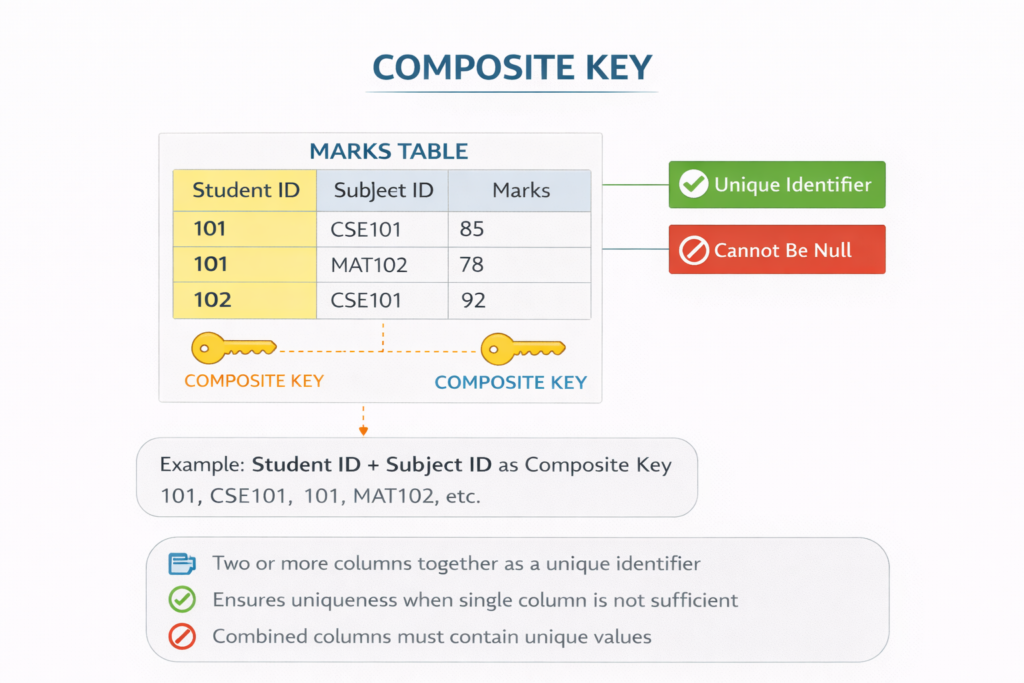
A composite key is a key made using two or more columns together to uniquely identify a record. It is used when a single column is not enough to ensure uniqueness. For example, in a marks table, student ID and subject ID together can form a composite key. Individually, they may repeat, but together they remain unique. Composite keys are very useful in relational databases. Interviewers include this topic in database management system interview questions and answers to test understanding of multi-attribute uniqueness.
25. What is a unique key?
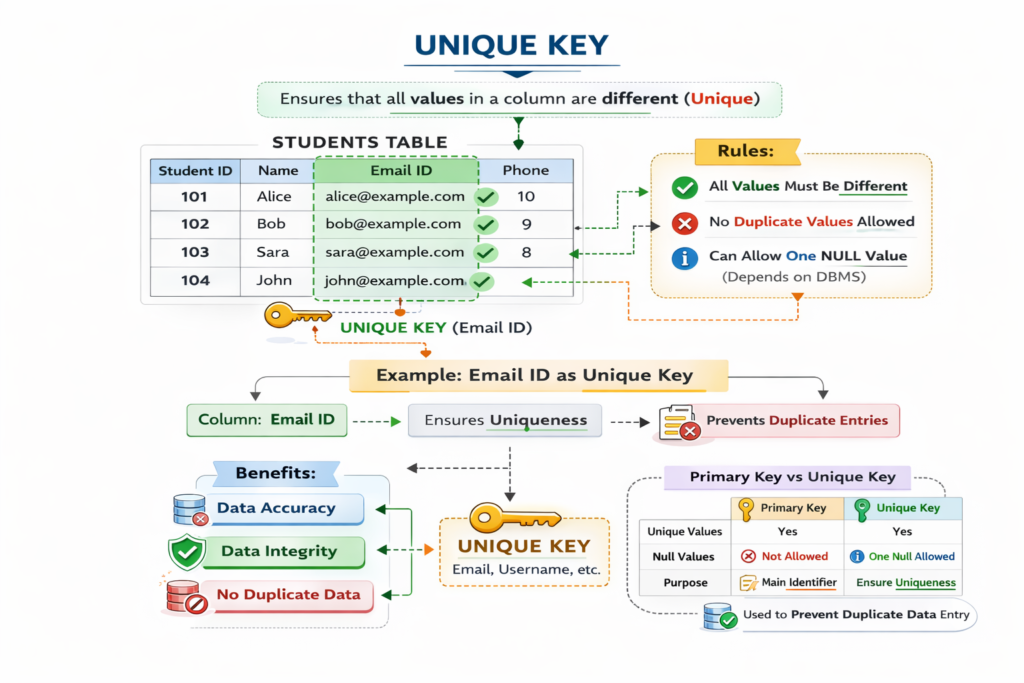
A unique key ensures that all values in a column are different from each other. Unlike a primary key, a unique key can allow one null value depending on the database system. It helps prevent duplicate data entry. For example, an email ID is usually defined as a unique key. Unique keys improve data accuracy and integrity. This concept is frequently asked in interview questions in database management systems because uniqueness is a major requirement in real-world applications.
26. What is an entity in DBMS?
An entity is a real-world object that can be identified uniquely and has attributes. Examples include student, employee, customer, or product. Entities are the basic building blocks of database design. Each entity is represented as a table in the database. Entities help convert real-world concepts into database structures. Understanding entities is essential for designing ER diagrams. This question is very common in database management system interview questions for freshers.
27. What is an attribute?
An attribute describes the properties or characteristics of an entity. For example, student name, age, roll number, and address are attributes of a student entity. Attributes define what type of data will be stored in a table. Each attribute has a data type that restricts the kind of values it can hold. Proper attribute design ensures data accuracy and consistency. Interviewers frequently ask this in database management system interview questions and answers to test basic modeling knowledge.
28. What is an entity set?
An entity set is a collection of similar entities. For example, all students together form a student entity set. In a database, entity sets are usually represented as tables. Each row corresponds to one entity, and columns represent attributes. Entity sets help organize data logically and systematically. Understanding entity sets is important for ER modeling and database design. This topic often appears in interview questions in a database management system.
29. What is a relationship in DBMS?
A relationship represents an association between two or more entities. For example, a student enrolls in a course, which creates a relationship between the student and the course entities. Relationships help define how tables are connected. They are essential for maintaining data integrity and enabling joins. Relationships are represented using foreign keys in relational databases. This is a fundamental concept in database management system interview questions for freshers.
30. What is a relationship set?
A relationship set is a collection of similar relationships. For example, all enrollments between students and courses form a relationship set. It defines how multiple entities interact with each other. Relationship sets are important in ER diagrams because they help visualize data connections clearly. Interviewers often include this topic in database management system interview questions and answers to test ER model understanding.
31. What is cardinality in DBMS?
Cardinality defines the number of entity instances that can be associated with another entity. It describes relationship types such as one-to-one, one-to-many, and many-to-many. For example, one teacher can teach many students, which is one-to-many. Cardinality helps in proper database design and avoids logical errors. This concept is extremely important and frequently appears in interview questions in database management systems.
32. What is the degree of a relationship?
The degree of a relationship refers to the number of entities involved in the relationship. If two entities are involved, it is called a binary relationship. If three entities are involved, it is a ternary relationship. Most real-world relationships are binary. Understanding the relationship degree helps in ER diagram design. This question is often included in database management system interview questions for freshers to check modeling concepts.
33. What is an ER model?
The Entity Relationship (ER) model is a conceptual database design model used to represent real-world entities and their relationships. It helps designers visualize the database structure before actual implementation. ER model uses entities, attributes, and relationships represented through diagrams. It simplifies communication between developers and stakeholders. ER modeling is a foundation of database design, which is why it is heavily asked in database management system interview questions and answers.
34. What is an ER diagram?
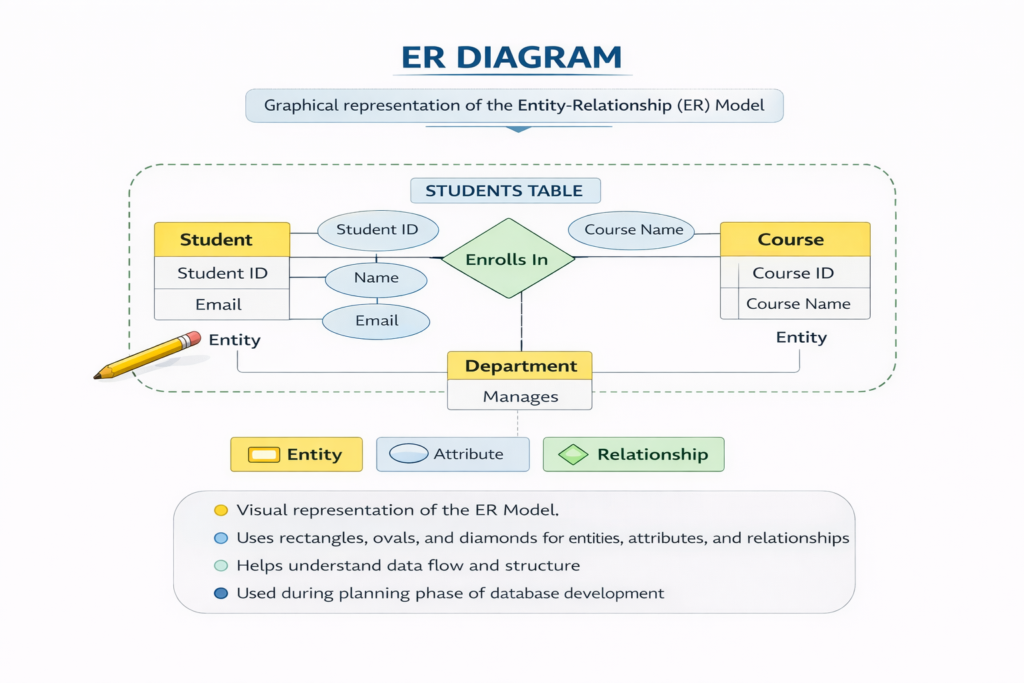
An ER diagram is a graphical representation of the ER model. It uses rectangles for entities, ovals for attributes, and diamonds for relationships. ER diagrams help in understanding data flow and structure easily. They are used during the planning phase of database development. ER diagrams reduce errors and improve clarity. Interviewers frequently ask about ER diagrams in interview questions in database management systems.
35. What is a weak entity?
A weak entity is an entity that cannot be uniquely identified by its own attributes. It depends on another strong entity for identification. For example, a dependent entity depends on an employee entity. Weak entities use partial keys and are connected through identifying relationships. This concept is important in ER modeling and appears in many database management system interview questions.
36. What is a strong entity?
A strong entity is an entity that can be uniquely identified by its own attributes. It does not depend on any other entity. For example, a student or employee is a strong entity because it has a unique ID. Strong entities form the core of database design. Understanding the difference between strong and weak entities is commonly tested in database management system interview questions and answers.
37. What is the participation constraint?
The participation constraint defines whether an entity must participate in a relationship or not. It can be total or partial participation. Total participation means every entity must be involved in the relationship. Partial participation means participation is optional. For example, every employee must belong to a department, but not every department must have employees. This concept is important in ER modeling and often appears in interview questions in a database management system.
38. What is specialization?
Specialization is a top-down approach in ER modeling where a higher-level entity is divided into lower-level entities. For example, employees can be specialized into permanent and contract employees. Specialisation improves clarity and reduces redundancy. It helps represent real-world hierarchy effectively. Interviewers often ask this topic in database management system interview questions for freshers.
39. What is generalisation?
Generalization is the bottom-up approach in ER modeling. It combines lower-level entities into a higher-level entity. For example, a car and a bike can be generalized into a vehicle. Generalization simplifies design and reduces complexity. It improves the reusability of attributes. This concept is commonly asked in database management system interview questions and answers.
40. What is aggregation in DBMS?
Aggregation is an abstraction concept used to represent relationships among relationships. It allows treating a relationship as an entity. Aggregation is useful when a relationship itself has attributes. It helps model complex real-world scenarios. Though advanced, it is important for a deep understanding. Interviewers may include this in interview questions in a database management system to test advanced ER modeling knowledge.
Conclusion
Database Management System is one of the most important subjects for computer science students and IT job seekers. Whether you are a fresher or an experienced professional, database management system interview questions will always be part of your career journey.
By understanding DBMS in simple and layman's language, you can confidently answer interview questions in database management systems, clear technical rounds, and perform well in real projects. If you master these fundamentals, SQL, normalisation, keys, joins, and transactions will no longer feel confusing. Instead, DBMS will become one of your strongest subjects.