
In the last few years, Generative AI (Gen AI) has become one of the most exciting and fast-growing areas in technology. It’s what powers tools that can write articles, draw images, compose music, generate videos, or even write code, all automatically. Unlike traditional AI, which mainly analyses data or makes predictions, Generative AI creates something new. It learns patterns from massive datasets and then uses that knowledge to generate fresh, realistic content.
That’s why Gen AI interview questions are now appearing everywhere, from campus placements to senior AI engineer roles. This blog is designed to help both freshers and experienced engineers prepare in an easy, structured way. You’ll find simple explanations, key concepts, practical examples, and real-world interview tips, all written in plain English, without jargon or copied text.
What You’ll Learn in This Blog
- What Generative AI really means, in plain terms
- Why it’s important for engineers
- Core topics you must know before your interview
- Common interview questions for freshers
- Deeper, scenario-based questions for experienced engineers
- Behavioural and ethics questions
- Real-world tips to stand out in interviews
- A final checklist for last-minute revision
Understanding Generative AI in Simple Words
Let’s start with the basics. Generative AI is a field of artificial intelligence that focuses on creating data rather than simply analysing it. It learns from existing examples, like text, images, music, or code, and then generates new examples that follow similar patterns.
For example:
- ChatGPT can write human-like text.
- DALL·E can create artwork from a sentence.
- GitHub Copilot can suggest code.
- DeepFake systems can make realistic videos.
All these are powered by generative models, which use neural networks trained on large datasets to mimic creativity.
How It Works (in easy terms)
Imagine showing a model thousands of cat pictures.
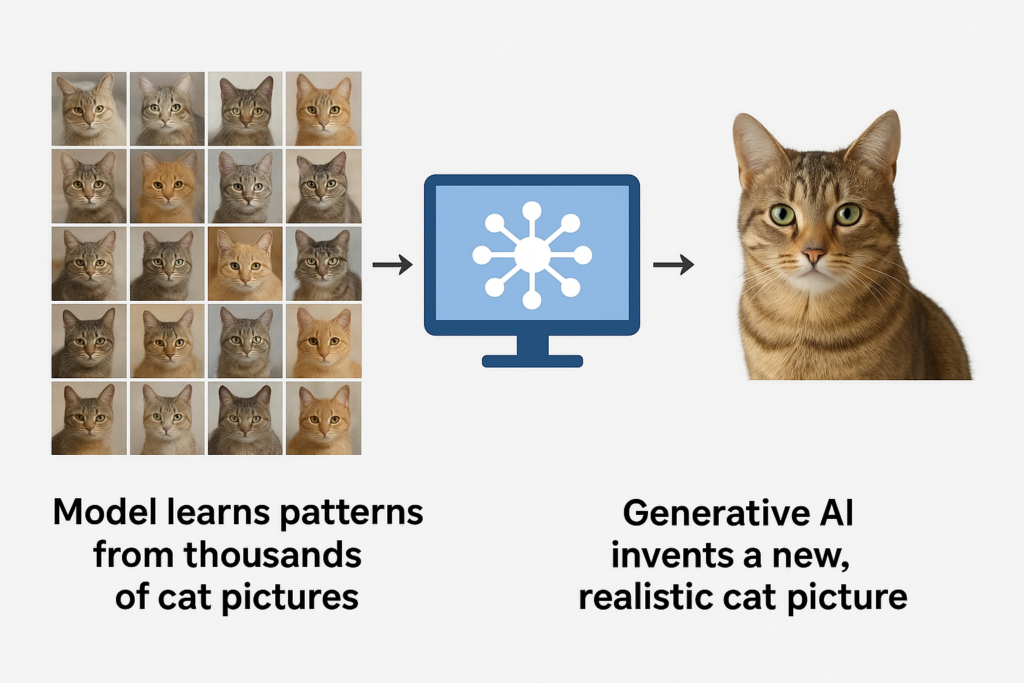
After training, the model doesn’t just memorise them, it learns the structure of what makes something look like a cat: fur texture, shape, eyes, and colour.
Later, when asked, it can generate a completely new cat picture that looks real, even though it has never existed.
That’s the magic of generative AI, learning patterns so deeply that the system can invent realistic new data.
Why Generative AI Skills Matter in Today’s Job Market
Generative AI isn’t just a buzzword anymore, it’s a practical skill employers look for. Here’s why engineers are in such high demand:
- Widespread adoption: Every industry is exploring Gen AI for automation, personalisation, and creativity.
- Integration into products: Modern apps often include Gen AI features summarising emails, creating designs, or writing content.
- Cross-domain use: Knowledge of Gen AI helps in roles across data science, software engineering, cloud, design, and analytics.
- Career growth: Engineers who understand how to build, fine-tune, and deploy generative models have a big advantage in AI-driven companies.
Whether you’re a fresher preparing for your first interview or an experienced developer switching into AI, understanding how generative systems work and how to explain them is a must.
Core Concepts You Should Know
Before facing an interview, make sure you’re comfortable with these ideas. Here’s a simple overview:
| Concept | Simple Explanation |
| Transformer Models | Neural networks that read input sequences (like words in a sentence) and generate outputs based on attention, used in LLMs like GPT. |
| Attention Mechanism | A process that helps models “focus” on the most relevant parts of input when creating an output |
| GAN (Generative Adversarial Network) | Two models compete, one creates data, the other judges it, improving realism over time. |
| VAE (Variational Autoencoder) | Compresses data into a hidden (latent) space and reconstructs new, similar data from it. |
| Latent Space | A compact internal map where the model stores patterns of features it has learned. |
| Prompt Engineering | The art of designing good prompts to get the desired result from a large model. |
| Fine-Tuning | Adjusting a pre-trained model with your own data to make it domain-specific. |
| RAG (Retrieval-Augmented Generation) | Combines search (retrieving facts) with generation (creating responses) for better accuracy. |
| Hallucination | When a model confidently generates false or made-up information. |
| Evaluation Metrics | Tools to measure generation quality, like BLEU (text), FID (images), or human feedback. |
| Ethical Concerns | Bias, misinformation, plagiarism, and misuse of generated content. |
Knowing these concepts and being able to explain them in simple words is often more valuable in an interview than quoting formulas.
Interview Questions for Freshers (With Easy Answers)
If you’re new to the AI field, interviewers mainly test your understanding of concepts and your curiosity about how things work. Here are some beginner-friendly questions and sample answers.
Q1. What is Generative AI?
Answer: Generative AI is a type of artificial intelligence that learns from existing data and creates new content like text, images, or music. Instead of just predicting or classifying, it produces original results that resemble real data.
Q2. How is Generative AI different from traditional machine learning?
Answer: Traditional ML focuses on making predictions, like whether an email is spam or not.
Generative AI focuses on creation, for example, writing an email from scratch. It doesn’t just choose between options; it generates new possibilities.
Q3. Can you explain a Transformer in simple terms?
Answer: A Transformer is a neural network that processes sequences (like sentences) all at once instead of one word at a time. It uses “attention” to decide which words are most relevant for generating the next word, making it powerful for text generation.
Q4. What is a GAN and how does it work?
Answer: A GAN has two parts generator that tries to make fake data, and a discriminator that tries to tell fake from real.
Both compete until the generator becomes good enough to fool the discriminator, producing realistic outputs like faces or artwork.
Q5. What are some real-life applications of Generative AI?
Answer:
- Chatbots and content writing tools
- Code generation assistants (like Copilot)
- Art, music, and video creation
- Data augmentation in ML training
- Virtual avatars and gaming assets
Q6. What is prompt engineering, and why is it important?
Answer: Prompt engineering means writing effective instructions for an AI model to get accurate results. A well-crafted prompt can dramatically change the quality of the model’s output, especially in tools like ChatGPT.
Q7. What are the main challenges in using Generative AI?
Answer:
- Hallucinations (producing false information)
- Ethical and copyright issues
- High computational cost
- Data privacy and bias
- Evaluating creativity objectively
Q8. What programming skills help in Gen AI?
Answer: Languages like Python, along with frameworks such as TensorFlow, PyTorch, or Hugging Face Transformers, are most useful. Basic knowledge of data preprocessing, APIs, and cloud deployment also helps.
Q9. What is the “latent space” in generative models?
Answer: Latent space is the hidden internal representation where the model stores learned patterns. When we generate new data, we sample from this space to create unique but realistic examples.
Q10. What are some ethical risks with Generative AI?
Answer:
- Creating misleading or fake information
- Copyright violations
- Bias in generated content
- Misuse for impersonation or fraud
Interviewers often check if you’re aware that responsibility is part of being an AI engineer.
Interview Questions for Experienced Engineers
If you already have hands-on experience, expect deeper questions that test design skills, trade-off thinking, and deployment experience.
Q1. Describe a project where you implemented a generative model.
Answer: Explain what the goal was, which model you used (GAN, Transformer, etc.), the dataset, and what challenges you faced.
Focus on resultsimproved quality, reduced time, or increased automation.
Mention technical an, d practical aspects like scaling, bias handling, or model evaluation.
Q2. How do you decide between fine-tuning a model and training from scratch?
Answer: It depends on:
- Data size: If you have limited data, fine-tuning works best.
- Resources: Training from scratch requires huge computing power.
- Timeline: Fine-tuning is faster and cost-effective.
- Control: Training from scratch gives more flexibility but more effort.
Q3. How do you evaluate generated outputs?
Answer: You can combine:
- Automated metrics (BLEU, ROUGE, FID, etc.)
- Human evaluation (fluency, relevance, realism)
- Task metrics (user satisfaction, click-through rates, error reduction)
- Evaluation depends on contextfor example, an image generator uses different metrics than a text generator.
Q4. How do you handle hallucinations in large language models?
Answer:
- Use Retrieval-Augmented Generation (RAG) to ground answers in real data.
- Implement post-generation validation or fact-checking rules.
- Fine-tune the model with curated data.
- Add disclaimers or human review for critical content.
Q5. What are the biggest deployment challenges for generative models?
Answer:
- Latency: large models can be slow; use optimisation or caching.
- Cost: inference is expensive; consider quantisation or smaller models.
- Monitoring: track drift, quality, and safety over time.
- Scalability: handle high user loads efficiently.
- Ethics & compliance: ensure outputs are safe and responsible.
Q6. How do you ensure fairness and reduce bias?
Answer:
- Audit and clean training data.
- Add balanced examples from all demographics.
- Monitor outputs for stereotypes or skewed language.
- Include human reviewers during testing.
- Use prompt templates that neutralise bias.
Q7. What is Retrieval-Augmented Generation (RAG)?
Answer:
RAG combines two steps:
- Retrieval: Searching for relevant information from a database or documents.
- Generation: Feeding that data into a generative model to produce factual, up-to-date answers.
It helps prevent hallucinations and makes models more reliable for enterprise use.
Q8. How would you detect and fix “mode collapse” in a GAN?
Answer: Mode collapse happens when a GAN keeps generating similar outputs.
To fix it:
- Adjust learning rates or regularisation.
- Use better loss functions like WGAN-GP.
- Improve dataset diversity.
- Add mini-batch discrimination.
Q9. What monitoring systems would you set up for a live Gen AI application?
Answer:
- Track generation quality scores.
- Monitor user feedback and error rates.
- Log prompts and outputs for auditing.
- Detect drift or bias in responses.
- Regularly retrain or fine-tune the model with fresh data.
Q10. How do you ensure ethical and safe use in deployed models?
Answer:
- Implement filters for inappropriate or harmful content
- Add disclaimers or human review.
- Follow data privacy laws and copyright rules.
- Continuously test for fairness and bias.
Scenario-Based Questions
Interviewers love practical scenarios that test your thinking. Here are some examples with ways to approach them.
Scenario 1: Building a Customer Support Chatbot
Approach:
- Identify the goal (help customers quickly).
- Use a base LLM fine-tuned on past tickets.
- Combine retrieval (search in FAQs) + generation (LLM response).
- Add human fallback and toxicity filters.
- Measure success with response accuracy and user satisfaction.
Scenario 2: Outputs Are Becoming Irrelevant
Approach:
- Check for data drift. Are inputs changing?
- Retrain or fine-tune on recent data.
- Add feedback loops to improve with user corrections.
- Update retrieval databases regularly.
Scenario 3: Image Generator Produces Similar Results
Approach:
- This is likely a mode collapse.
- Add more diverse data.
- Modify training setup with advanced GAN loss functions.
- Introduce random noise and variation in sampling.
Behavioural and Soft-Skill Questions
Technical knowledge alone isn’t enough. Interviewers also check your teamwork, ethics, and communication.
Common questions:
- Tell me about a time you faced a problem in an AI project.
- How do you stay updated with new AI developments?
- How do you explain complex AI topics to non-technical people?
- What would you do if your model generated biased or harmful content?
Tips for answering:
- Use the STAR method, Situation, Task, Action, Result.
- Focus on what you did, not just what the team did.
- Emphasise learning, collaboration, and accountability.
- Always end with a positive outcome or a lesson learned.
Best Tips for Acing a Generative AI Interview
- Simplify your explanations: Interviewers value clarity over buzzwords.
- Show understanding, not memorisation: Explain why something works, not just what it is.
- Give examples: Even a small college project counts if you explain your thought process.
- Stay calm on unknown questions: Admit what you don’t know and explain how you’d find out.
- Demonstrate awareness of ethics: Responsible AI thinking leaves a strong impression.
- Stay current: Follow recent Gen AI models and trends, diffusion models, LLM updates, etc.
- Practice mock interviews: Record yourself explaining transformers, GANs, or RAG in simple terms.
Conclusion
Generative AI is transforming the world of technology. Whether you’re a beginner or an experienced engineer, understanding how these models learn, create, and behave responsibly will set you apart in interviews. Remember, you don’t have to memorise everything. Focus on understanding the concepts, being able to explain them clearly, and showing that you can think through real-world situations logically. In every interview, your goal is to communicate curiosity, clarity, and responsibility. Generative AI is not just about machines learning to create, it’s about humans learning to use creation wisely.